


What will a second Trump presidency mean for international education?




- Donald Trump’s election win will upend the current immigration landscape in the US, with likely implications for international students
- The US has recently become more competitive relative to Canada and the UK in terms of international student interest
- Studyportals registers a surge of interest among American students for study abroad
After a hotly contested and close-run campaign, former President Donald Trump was declared the winner of the 2024 presidential election this week in the United States. The president-elect will be sworn in as America's 47th president in January 2025.
Mr Trump's second term will have wide-reaching ramifications for the United States and the wider world, and it may affect flows of international students into the US.
First Trump presidency characterised by deep suspicion of foreigners
Mr Trump’s first presidency, from 2016 to 2020, was marked by a notable decline in foreign student interest in the US and by more restrictive policies affecting student mobility from major student markets.
It featured the infamous “Travel Ban 3.0,” which restricted access to study in the US for students from Iran, Libya, Somalia, Syria, Yemen, North Korea, and Venezuela, and a rise in visa refusals for Chinese students. At a private dinner in 2018, Mr Trump declared that “almost every student” from China studying in the US was a spy. International enrolments in the US dropped by 12% during the first Trump presidency, and denials of H-1B visa extensions rose from 3% to 12%.
Writing in Forbes before the election, Stuart Anderson opined: “If Donald Trump regains the presidency, international students and applicants for employment-based green cards may find Trump’s immigration policies will affect them more profoundly than many today imagine.”
International students undeterred
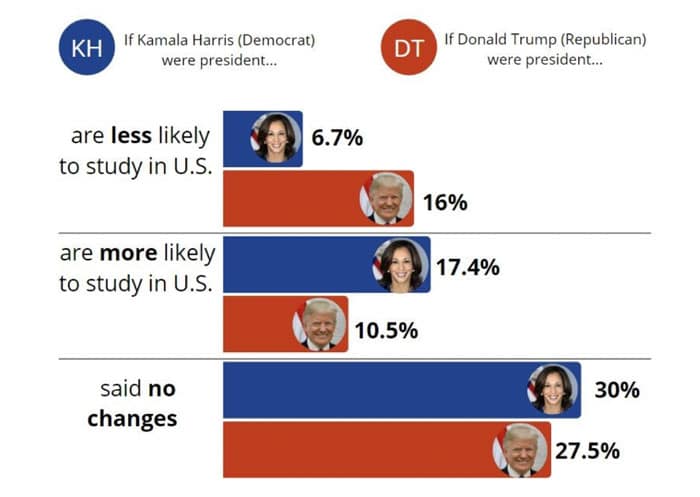
However, prospective international students surveyed this year were notably indifferent to what the results of the election would be, as shown in the following chart from Studyportals/Intead.
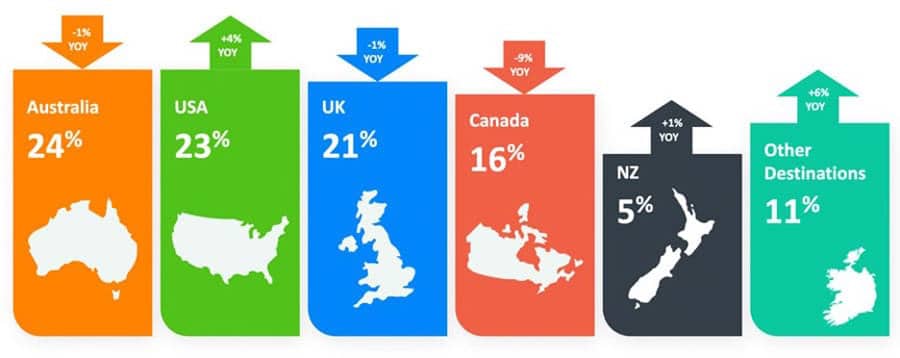
In the weeks before the election, the US was virtually tied with Australia as the most-preferred destination according to IDP research conducted in August–and September 2024 with 6,000+ student respondents in 114 countries.
The sector reacts to the election results
Industry leaders pointed to a clear need to educate the new government about the value of international education. Dr Fanta Aw, executive director and CEO of NAFSA: Association of International Educators, said:
“For more than 75 years, NAFSA has advocated for policies that expand the reach and impact of international education. We remain committed to educating the incoming administration and Congress on the regulatory changes and policies that will strengthen the field and extend opportunities for global learning ….
With increasing competition for the world’s best and brightest students, and only a small fraction of U.S. college students studying abroad, US global competitiveness is at stake. Working with Congress and the Trump administration, we will advocate for policies that strengthen the U.S. role in research, workforce development, knowledge diplomacy, and national security. International education is a vital asset to the United States.”
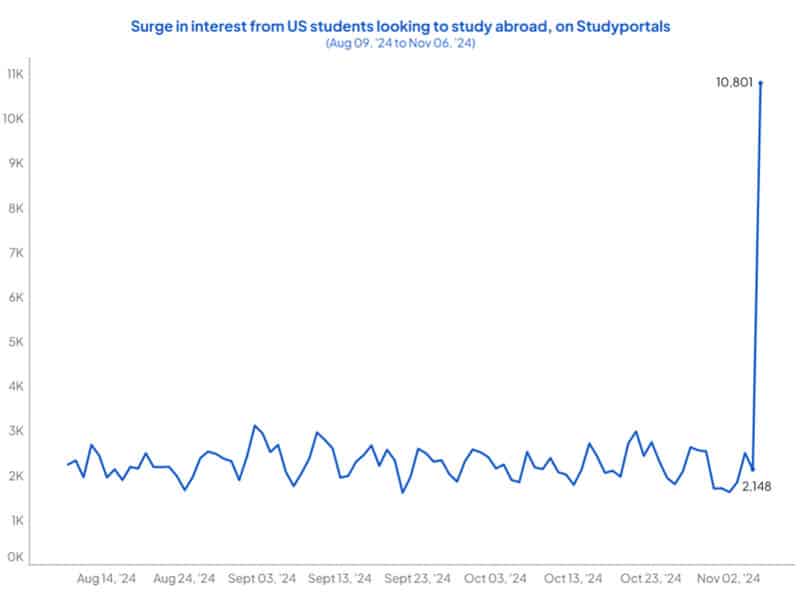
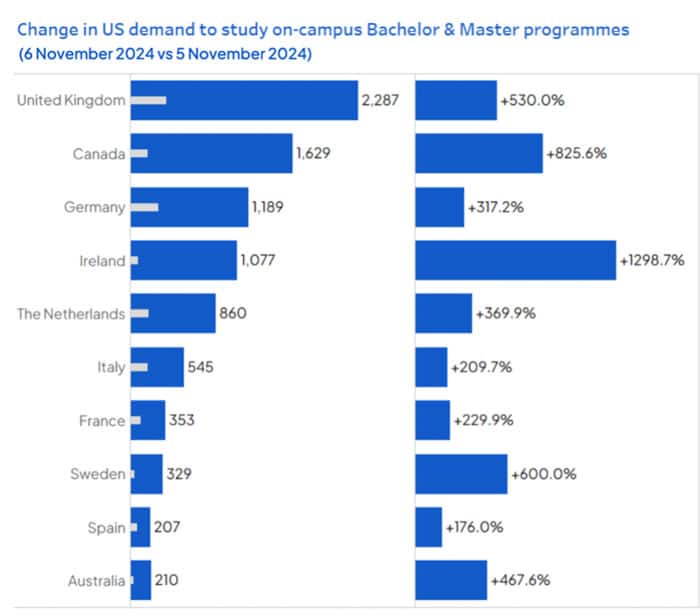
Whatever it will mean for international enrolments in the US, Mr Trump’s win may lead to growth in the number of US students studying abroad. Studyportals registered a huge spike in interest from US students in November 2024, as shown in the charts below. In particular, more US students are exploring study in the UK, Canada, Ireland, and Germany.
Domestic higher education landscape may be transformed
Some observers anticipate that Trump's second term will see a greater focus on domestic reforms of higher education. A 6 November report in Inside Higher Ed, for example, outlines that, "A second Trump administration will likely ramp up scrutiny of colleges and universities and empower advocates for sweeping reform of the sector during a historically unstable time for American higher education. As enrolments flounder and public disillusionment with college cost grows—and after a year of negative public attention over campus protesters and federal policy blunders on student debt and financial aid—that shift could have transformative implications for higher ed."
Need to highlight the value of global education
Responding to a LinkedIn post by NAFSA’s Dr Fanta Aw, Nannette Ripmeester, i-graduate’s director of client services for Europe and North America, wrote:
“We, the entire global higher education community … need to explain to the communities around us, from politicians, policymakers, to the general public why higher education and study abroad matter. We talk amongst ourselves, now let’s reach outside of the international education field to take people on a journey and underline the value of our work.”
Miriam Feldblum, executive director of the Presidents’ Alliance, issued this statement:
“In a post-election environment of uncertainty and anxiety for many on our campuses, our commitment to students, staff, and faculty from around the world remains steadfast, as does our belief in their essential role in our nation’s economic vitality and competitiveness.”
For additional background, please see:
Most Recent
-
Decline in Indian demand a major factor in softer outlook for foreign enrolment in US higher education in 2026/27 Read More

-
Australia: As visa applications from foreign students fall, the government has set the national target for new international students in 2027 Read More
-
Independent K-12 schools in the UK hosting fewer international students this year Read More







