


Impact of UK’s dependant visa policy shows as nearly half of business schools miss targets




- More than four in ten UK business schools say that they will miss their 2023/24 recruitment targets for non-EU students
- Most respondents to a recent survey say that the government’s decision to limit visas for accompanying dependants as of January 2024 is a factor
- In response, some institutions moving selected post-graduate programmes online, and/or placing a greater emphasis on undergraduate recruitment
In what appears to be an early signal of the impact of an important change to UK visa policy, nearly half (44%) of the country's business schools are reporting that they will miss their non-EU recruitment targets this year.
The finding comes from the 2023 Chartered Association of Business Schools (CABS) Annual Membership Survey.
When reporting on performance against non-EU recruitment targets for the 2023/24 academic year, nearly three in ten responding institutions (29%) said they had either significantly or moderately exceeded their goal. Another 27% said they had met their recruitment target. But the remaining 44% said that they fell short of their recruitment goals, of which 22% reported being "significantly below" their target enrolment. The survey report adds: "There is significant variation in the results by level of study for non-EU international enrolments, as at undergraduate level nearly half of the schools either significantly or moderately exceeded target compared to one-third of schools at postgraduate level. At postgraduate level nearly 50% of schools reported recruitment that was either significantly or moderately below target for non-EU international students, compared to 21% at undergraduate level."
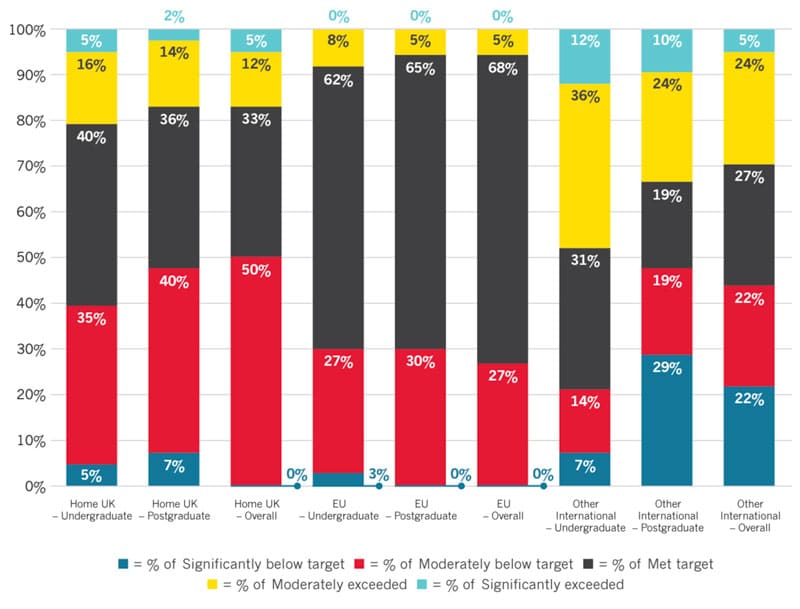
Survey respondents reported that they were seeing some of the most significant increases in non-EU enrolment from India, Pakistan, and Ghana. "All these countries had more business schools seeing increases in enrolments for the new academic year than decreases," notes the report. "Growth in enrolments from Nepal and Saudi Arabia were also cited by several schools. None of the schools cited decreases in enrolments from Nepal, Pakistan and Saudi Arabia."
The most frequently cited countries for declining enrolments were China and Nigeria, "which could suggest a reversal in the growth in recruitment from these key countries in recent years."
The dependant visas factor
In May 2023, the British government announced that international students would be prevented from bringing dependants with them as of January 2024 (unless students are in postgraduate programmes with a research focus). The Home Office said at the time that almost half a million student visas were issued in 2022 while the number of dependants of overseas students has increased by 750% since 2019, to 136,000 people. The move to limit accompanying dependents was explicitly done to curb net migration, and was described by the Home Secretary as the “single biggest tightening measure a government has ever done."
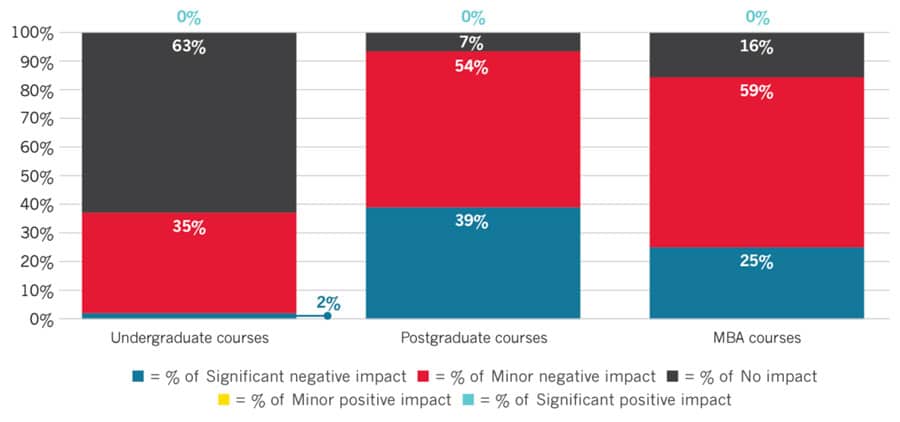
The vast majority of respondents to the CABS survey said that they expect to see negative impacts on non-EU enrolment arising from the policy. The report explains: "It is anticipated that enrolments for MBA programmes will be most affected as MBA students tend to be older and often wish to bring their family with them. Other post-experience programmes, such as Executive Education programmes sponsored by a company, are also expected to be more adversely impacted due to students being more likely to have children."
"Many [respondents] mentioned that the change has prompted them to reassess their school’s strategy which includes shifting MBAs and Master’s programmes to online delivery if not already offered in this mode, and focusing on growing international student numbers at undergraduate level instead. There is also a sense that the recruitment of business schools in competitor countries such as Australia and Canada is already benefitting from the UK’s decision to ban visas for dependents of students."
The revenue impact
The survey finds overall that UK universities remain highly reliant on business school tuition revenue, and that, with the downward pressure on non-EU enrolments for this year in particular, that the financial outlook for the year ahead is weakening. "While 28% and 49% of respondents in 2022 stated that they expected significant and moderate increases in income respectively, these numbers have fallen to 9% and 36% in this year’s edition of the survey. 30% of business schools expect a decrease in income compared to only 2% in last year’s survey."
For additional background, please see:
Most Recent
-
England: Government “remains of the view” that the International Student Levy should go ahead; implementation planned for August 2028 Read More

-
Decline in Indian demand a major factor in softer outlook for foreign enrolment in US higher education in 2026/27 Read More
-
Australia: As visa applications from foreign students fall, the government has set the national target for new international students in 2027 Read More







