


US: Indian enrolments surging for fall 2022 as Chinese numbers decline




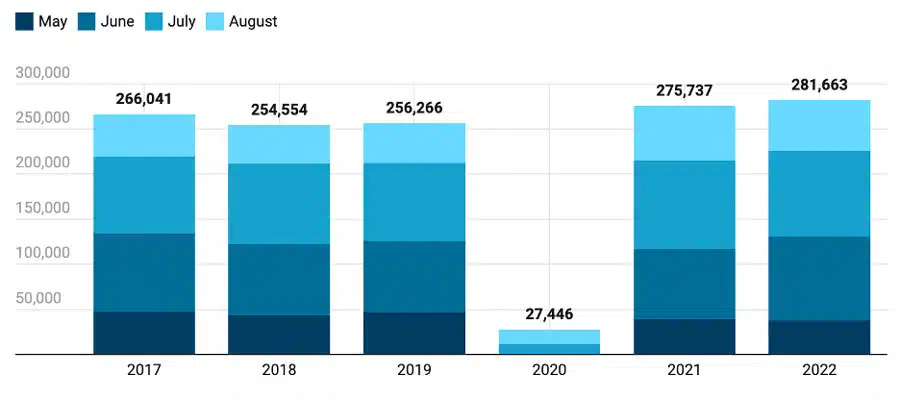
- From May to August 2022, US immigration officials granted 282,000 new F-1 student visas – up 2% since 2021 and 10% higher than pre-pandemic levels
- Indian students are driving the recovery, offsetting a steep decline in the number of Chinese students choosing to study in the US
The latest data release from the US Customs Student and Exchange Visitor Immigration Program (for September 2022) indicates that Indian enrolments are surging in the US. Chinese enrolments, by contrast, are continuing to decline.
Overall, the number of F-1 visas issued to international students for the period May through August 2022 (282,000) is slightly higher than in the same months of 2021 (+2%) and 10% higher than in 2019, according to analysis of US Department of State data conducted by The Chronicle of Higher Education.
Chinese outbound to US plummets
In May to August 2022, 45% fewer F-1 visas were issued to Chinese students, a larger decline from this source market than in 2021. The Chronicle explains that several factors precipitated the steep falloff, from rising US-China tensions during the Trump Administration to the fact that for many months of the pandemic, Chinese students found it even more difficult to travel to the US than other international students:
“The early outbreak of COVID in China led the US government to impose a travel ban on visitors, including student-visa holders, from China in the first months of the pandemic, and it was not lifted until May 2021. As a result, any student coming from China had to first travel to a third country and quarantine. There were few flights between the two countries, and American consulates were closed. During the summer of 2020, only about 500 visas were issued to Chinese students.”
For the moment, it appears as though Chinese students are turning away from North America, and towards Europe – especially towards the UK – if they are choosing to travel outside of the country for degrees. The number of study permits issued to Chinese students for study in Canada declined by 9.6% in 2021. By contrast, applications from Chinese students to attend undergraduate programmes in UK universities for the coming academic year grew by 12% in 2022, and over the five-year period from 2016/17 to 2020/21, the number of students from China in the UK increased by 50%.
India is driving recovery
If it weren’t for India, the recovery of the US international education sector might be in calamitous state given the fall in Chinese enrolments. But as per the Chronicle, this is what happened to Indian enrolments in US institutions between May and August of 2022:
“More than 84,000 student visas were issued to Indian students over the summer — 45% more visas than during the same four months last year and a staggering 148% more than during that span in 2019.”
The surge in the number of Indian students is not unique to the US. In the UK, the number of Indian students rose from 55,465 in 2019/20 to 84,445 in 2020/21. That change means that the proportion of Indian students within the total international student population in the UK rose from 10% to 19% within the span of one year.
In Canada, Indian student numbers jumped 21% between 2020 and 2021 for a total of 217,410. Indian students alone make up 35% of Canada’s total international student population.
For additional background, please see:
Most Recent
-
Decline in Indian demand a major factor in softer outlook for foreign enrolment in US higher education in 2026/27 Read More

-
Australia: As visa applications from foreign students fall, the government has set the national target for new international students in 2027 Read More
-
Independent K-12 schools in the UK hosting fewer international students this year Read More







