



Study shows contrasting higher education enrolment trends across world regions




- A comprehensive new analysis tracks global demand for higher education from 2006 through 2018
- The study finds sharply contrasting trends between the developed economies of the Global North and the surging (or emerging) economies in the South
Broad patterns are observable in the models that project higher education enrolments globally in the decades ahead. These models point to significant growth in overall enrolments, and of corresponding growth in international student numbers in particular. They also suggest a shifting demand-supply dynamic that suggests that we should anticipate some downward pressure on post-secondary fees in the medium term.
To that broad understanding of the outlook for our sector, we can add additional analysis from a new study by industry research specialists Higher Education Strategy Associations (HESA). In their just-released World Higher Education: Institutions, Students and Funding, the HESA team provides a rich overview of global higher education.
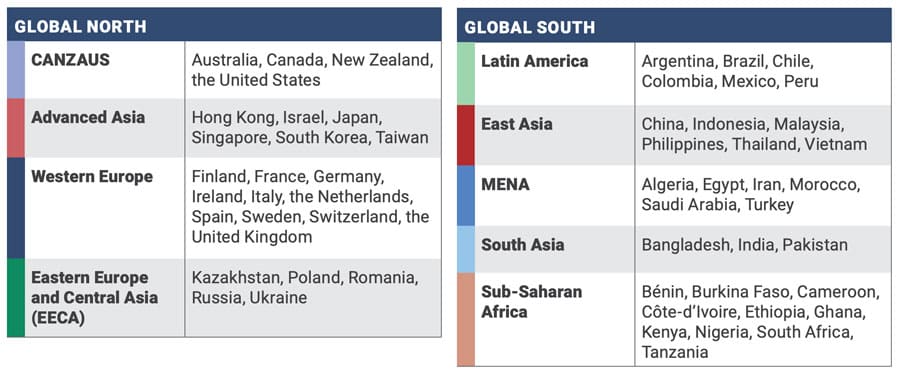
The study defines and distinguishes higher education demand patterns for the Global North and the Global South. That distinction is important: the trends are very different for each of those global regions.
"Because higher education is usually a lagging indicator of economic development, it made sense not to group countries by current economic conditions or GDP but rather by historical ones," explains the HESA report. "For that reason, the Global South and Global North categories more or less line up with what used to be called the 'developing world' or 'Third World' on the one hand and the 'developed world' or 'First/Second World' on the other." The following table outlines the regions and countries that belong to each grouping.
A tale of two regions
"Global higher education (HE) grew enormously from 2006 to 2018, both in terms of student numbers, which passed 200 million, and institutional numbers, which rose to almost 90,000," explains the report. "There are two important caveats to this story, however. The first is that growth was highly uneven: in some countries, enrolments grew explosively, while in a significant number of countries in the Global North, enrolments actually declined. The second is that overall growth slowed significantly. We have not yet reached the point where global enrolments have peaked, but such a point is becoming at least conceivable."
HESA points out in fact that total HE enrolments in the Global North peaked in 2011 and have been trending downwards since, to a point that is roughly on par with total student numbers in the region in 2006. In contrast, HE enrolments in the Global South continue to climb steadily. In 2006, the region accounted for about half of global HE enrolments; by 2018, it represented nearly three-quarters of the world total. HESA adds, "In other words, global HE is no longer dominated by wealthy countries, and global academia’s centre of gravity has decisively shifted toward Asia."
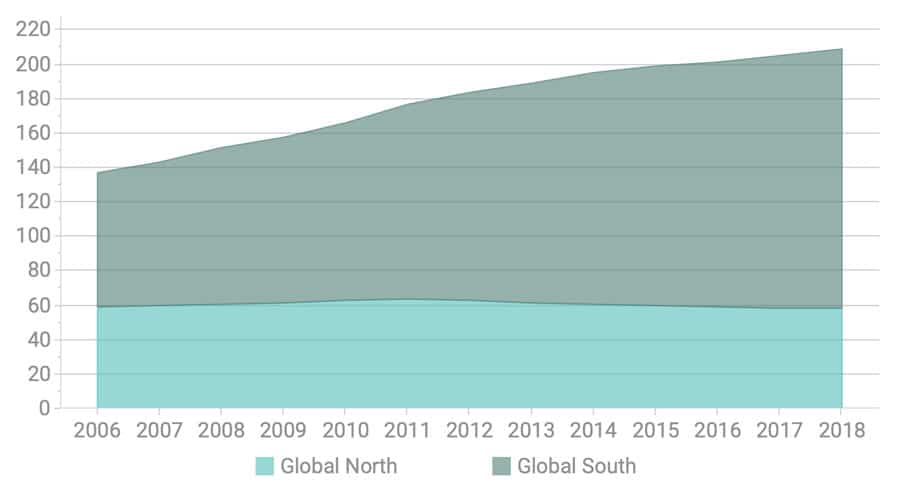
Not surprisingly, China and India play a big role in this shift, just as they do in driving demand for international student mobility. While the HESA report gathers data from 56 countries, just three of those countries – China, India, and the United States – account for nearly half of all higher education students worldwide, and about 54% of all higher education institutions. Increasing HE numbers in China and India have powered much of the growth for the Global South region. In contrast, the US saw its enrolments decline over the survey period.
The factors behind that downward trend are well understood, including underlying demographic trends (shrinking college-aged populations in particular) and the global financial crisis. The pandemic is placing additional pressure on enrolments in some Global North countries, including the US, as students interrupt or delay their higher ed studies in favour of work or other pursuits. As a recent item in the Washington Post points out, the number of college students in 24 of 50 US states actually declined by more than 4% between 2019 and 2021. "That’s an enrolment loss of nearly 1 million students," adds the Post. "Some drifted out of college, while others never started. Many colleges are on an urgent quest to keep current students and recover their lost freshmen."
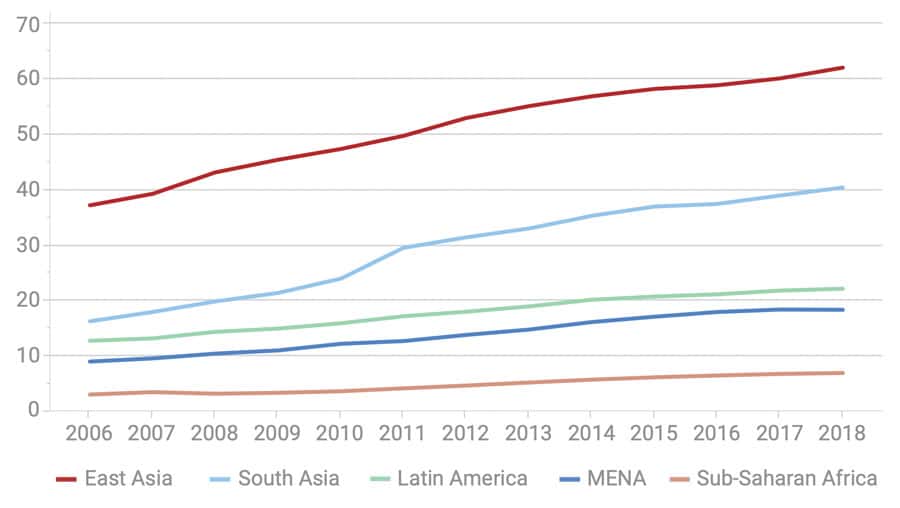
In contrast, enrolments grew across all Global South regions through 2018, although – as we see in the chart below – at a very different pace from region to region. The greatest absolute growth was in East Asia, followed by South Asia. Both areas were heavily influenced by the strong growth trends in China and India.
For additional background, please see: