Market intelligence for international student recruitment from ICEF
26th Oct 2016

Exploring international student expectations of study in the US


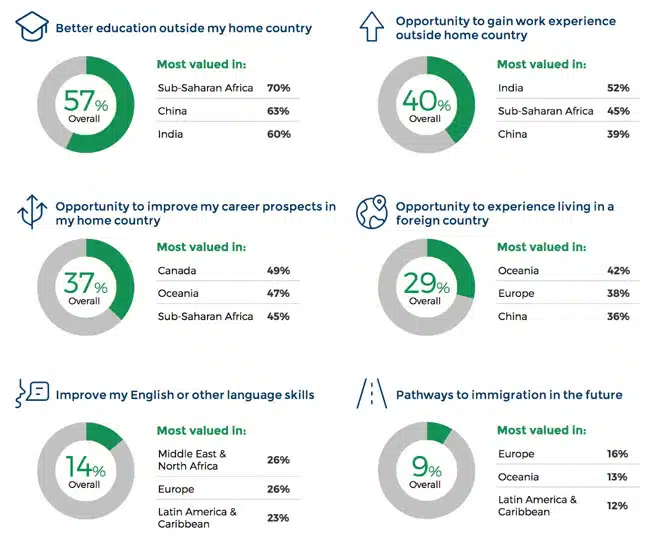
In May 2016, World Education Services (WES) conducted a survey of nearly 5,000 current and former international students in US higher education institutions. The results are focused on the US as the world’s leading study destination, and they carry with them some important recommendations and insights for international recruiters. In particular, Improving the International Student Experience: Implications for Recruitment and Support opens with an interesting summary of pre-arrival expectations of foreign students heading for the US. It points out that some of the major demand drivers for international student are:

  • A belief that they will receive a better quality of higher education abroad – that is, relative to that of their home country
  • A belief that study abroad will improve their career prospects (“Career and work prospects are huge motivators among almost all groups of students from all over the world,” says the report)
  • A desire to improve foreign language skills, particularly English
  • An interest in immigrating to another country, or at least to stay for a period of time after graduation

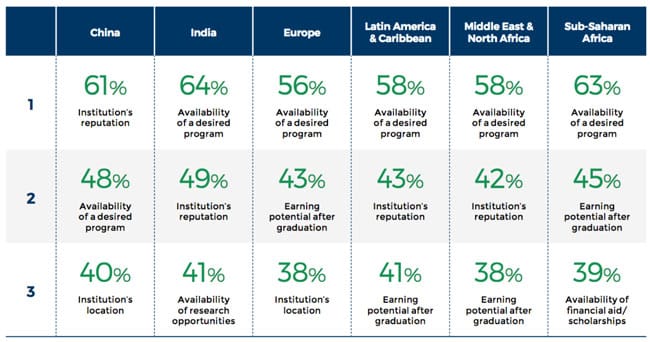
As the following infographic illustrates, quality of education and employment prospects were the dominant considerations for most students, with some notable variations by the students’ country or region of origin. wes-motivations Motivations to study abroad for foreign students enrolling in the US. Source: WES The survey also explored the factors that led students to choose a particular US institution. Far and away, the major factor cited by survey respondents was the availability of a desired programme. Nearly six in ten students cited this as their main consideration, a finding that underscores earlier research  as to the importance of unbranded search activity among prospective students. More specifically, Google research has shown that that nine in ten prospective students don’t know which school they want to attend at the onset of the search process and they reflect this non-brand orientation in their search behaviour with queries that are much more focused on specific programme or degree searches. Among WES survey respondents, Chinese students were a notable exception in this regard in indicating they were much more swayed by institutional reputation (61% of Chinese respondents indicated that this was the primary factor influencing their choice of institution). top-three-factors-that-influenced-international-students-choice-of-institution Top three factors that influenced international students’ choice of institution. Source: WES The WES survey also included a sample of foreign students enrolled abroad, but not in the US. Those respondents, including students in the UK, Canada, Germany, and Australia, exhibited a similar response patterns as to the major factors driving their decision to study abroad – that is, similar to foreign students in the US. Finally, WES also explored why students who chose not to follow through on intentions to study in the US what led them to change their plans. Nearly one in three cited the cost of study in the US as the main reason, with other common responses including failure to obtain admissions at their institution(s) of choice and/or failure to obtain a US study visa. For additional research on student preferences and motivations for study abroad, please see “New survey reinforces career goals a primary motivation for study abroad”, “Survey says employment prospects the key for postgraduate applicants”, and “New report tracks key influencers for international students”.
Most Recent

  • Year in review: What we learned in 2025 Read More
  • US extends travel ban, Nigeria now included on “restricted” list Read More
  • Search and enrolment data foreshadows international enrolment trends for 2026 Read More

Most Popular

  • Which countries will contribute the most to global student mobility in 2030? Read More
  • Research shows link between study abroad and poverty alleviation  Read More
  • Beyond the Big Four: How demand for study abroad is shifting to destinations in Asia and Europe Read More

Because you found this article interesting

US extends travel ban, Nigeria now included on “restricted” list The Trump administration has announced an expanded list of countries whose nationals – including students applying for F,...
Read more
Search and enrolment data foreshadows international enrolment trends for 2026 The following is a guest post contributed by Keystone Education Group. Keystone Education Group’s 2025 data reveals a...
Read more
Canada: A case study of immigration policy impacts on postsecondary institutions and the wider economy In January 2026, Canadian higher education institutions will enter the third consecutive year of caps on new international...
Read more
Global trends in international enrolments and policies as we head into 2026 At the end of 2025, educators across major study abroad destinations are facing markedly different circumstances than in...
Read more
Canada announces international student cap numbers for 2026 and updated programme guidance Immigration, Refugees and Citizenship Canada (IRCC) announced this week that it expects to issue up to 408,000 study...
Read more
The power of data and narrative in building public support for international students In 2025, students in emerging markets have been aware of weaker public support for – and tighter restrictions...
Read more
Canada and the US are losing international student enrolments to Europe and Asia  Canadian and American universities are struggling amidst government policies meant to curb immigration and/or international student numbers. Meanwhile,...
Read more
There are more international students in the US than ever in 2025, but commencements are declining The IIE’s 2025 Open Doors Report on International Educational Exchange shows that the number of international students in...
Read more
What are you looking for?
Quick Links