


Italy rises as a study destination but struggles to retain foreign graduates




- Italy is fast becoming a preferred European study abroad destination
- The number of English-language programmes offered by Italian universities has risen dramatically, and those universities are climbing in world university rankings
- Despite many attractive features for international students, Italy is underperforming when it comes to retaining foreign graduates
- This is a major problem given Italy’s “super-aged” population and struggles with productivity
Italy is increasingly popular as a European study abroad destination, with international enrolments increasing by about +10% per year since 2022 – the second-fastest growth rate in Europe after Spain. The most recent government data published in 2024 shows 110,000 foreign students in Italy, up +14% from 2019.
In July 2025, Studyportals reported that Italy was the fifth-most-searched study destination in its database, behind only Canada, the UK, the United States, and Germany. Major increases in search activity came from Pakistan, Bangladesh, Nigeria, and Egypt.
European students account for about 44% of the foreign student population, led by Romanians, of whom there are over 11,000 enrolled in Italian universities. Asia is the next largest contributor of international students (31%, or 34,000). Africa trails in third, but it is the fastest-growing source region: the 16,000 African students in Italian universities represents a +53% increase since 2015.
The top 10 origin countries for Italian universities are Romania, Albania, China, Iran, and India (all contributing over 5,000 students); Turkey and Morocco (over 3,500 each); and Russia, Ukraine, and Pakistan (just under 3,000).
Significant expansion of English-taught programmes
Italy has expanded the number of university programmes it offers in English – a major draw for students from many countries where English is more useful for job candidates than Italian. A 2024 Studyportals/British Council report notes that it is now the fifth largest provider of these courses in Europe, up from seventh in 2019.
As you can see in the chart below, France and Italy were the only ones in the top 10 list of European countries supplying English-taught programmes (ETPs) on campus to have risen significantly since 2019. France expanded by +16.8% to 1,410 in 2024, while Italy nearly doubled that rate of growth (+30% to 1,250 in 2024). This is in contrast to Spain, Sweden, Denmark, and Finland, which have reduced their ETP supply.
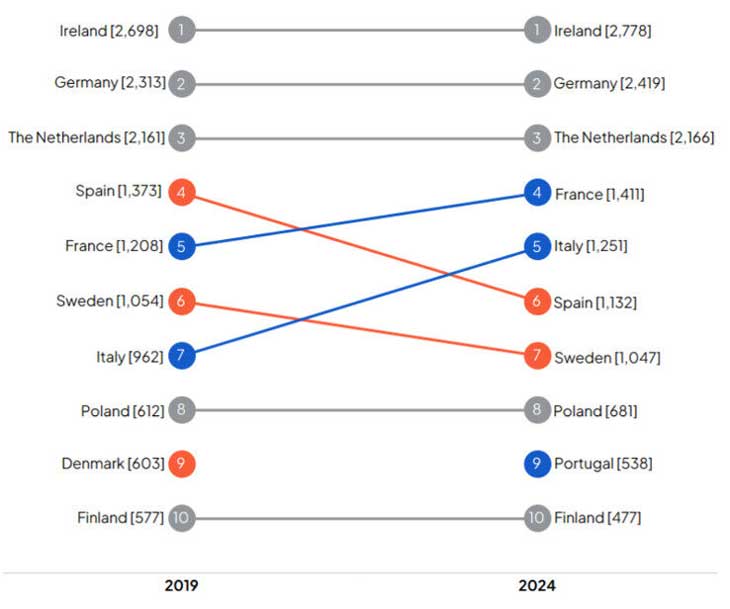
Of the roughly 90 universities in Italy, about 60 offer degree programmes taught in English. For example, University of Bologna (Università di Bologna) offers most of its programmes (just under 100) in English in such fields as AI, Electrical Vehicle Engineering, Genomics, and Economics. The Polytechnic of Milano (Politecnico di Milano) offers specialised ETPs in areas such as Interaction Design, Medicine and Biomedical Engineering, Space Engineering, and Nuclear Engineering. Those are just two prominent institutions – many other ranked Italian institutions are also offering ETPs in increasingly popular niche fields linked to skills gaps in the global economy.
Climbing the world rankings
The reputation and rank of universities is a top concern for international prospects with grades high enough to consider a prestigious institution. The Politecnico di Milano (Polytechnic of Milano) became the first Italian higher education institution to obtain a top 100 position in the QS World University Rankings in 2026 (98th), and Sapienza University of Rome (128th) and University of Bologna (138th) are in the top 200. In all, fifteen Italian universities made it into the top 500, and 43 are ranked in the scheme overall, putting Italy in second place in Europe after Germany in the overall ranking.
Italy’s attractiveness is also supported by an increasing focus on international partnerships, industry linkages, STEM excellence, and internship provision. Not least, Italy is … well, Italy, the fourth-most visited country in the world by tourists due to its culture, beauty, food, and more. This plays a large part in the allure of the country to international prospects choosing where to study.
Affordability
Italy can also attribute its growing popularity to its relative affordability, with fees ranging from €500 to €4,500 per year for bachelor’s and master’s courses. This depends on the programme and institution, of course.
Non-EU students need a long-term D visa to study for more than three months in Italy, but this costs only about €50 (US$60) when they apply through a consulate. This is lower than for study permits for France, Germany, and Canada, and vastly lower than for the US, UK, and especially Australia. Italy does ask for proof of funds, but at about €6,080 per year (just over US$7,000), this is less than half the required funds for Canada, Australia, and the UK. It is also about half the amount Germany requires, and it is slightly lower than for France.
The cost of living, like everywhere else, depends on which region and city students choose to study in. Study.eu says, “As a principle, you’ll need somewhere between €900 and €1,300 a month to cover rent, food, transportation, entertainment, etc.”
Medical appointments are free for EU students, but for non-EU students, the cost of health insurance jumped in 2024 to €700 per year, which is higher than the cost in France and Spain.
Part-time work is also permitted for non-EU students to help offset their costs of study (up to 20 hours a week).
Italy’s main challenge is retaining top international graduates
Italy is clearly attracting more international students, but it is performing less well at retaining them due to bureaucratic hassles including confusing and drawn-out document conversion, employment issues, and barriers to permanent residency.
Italy has one of the lowest proportions of working-age foreign residents with a university degree in the EU (11.7% vs. the 28% average).
This is a problem: Italy is one of the world’s most aged societies, with 25% of its population aged 65 or older, and its domestic higher education enrolment is declining. It needs infusions of talent into its economy, where labor force productivity has stagnated for a decade.
Several factors make staying in Italy a tough choice for both domestic and foreign students, including low salary rates for graduates. An August 2025 article featured in European Student Think Tank reported:
“Mercer Total Remuneration Survey (2024) ranks Italy among the EU’s lowest in terms of graduate compensation levels. As reported by Il Sole 24 Ore, Italy ranks near the bottom in terms of foreign graduate retention within the EU (2025).”
A 2024 report by Fondazione Nord Est found that: “After slowing in the two-year period 2020–2021, emigration of young Italians (18–34 years old) has resumed at the highest pre-pandemic rates, both in terms of exits and net migration.”
Speaking in January 2026 at the University of Messina, Bank of Italy Governor Fabio Panetta called this a crisis, noting that a young graduate in Germany earns on average 80% more than an Italian peer, while the gap with France is around 30%.
For international students, these compensation issues are exacerbated by work and immigration challenges. While foreign graduates are allowed 12 months to look for a job, transitioning to a work permit requires a formal job offer from an Italian employer and other conditions. And this is in a context of Italy having one of the highest youth unemployment rates in Europe.
As for remaining in the country over the long term, international graduates have to prove five years of legal, continuous residence in Italy; stable income of €7,002 per year; a level A2 in Italian; and a housing certificate to apply for permanent residence. Along with issues in finding work offering decent compensation, the five-year waiting period can be a turnoff for international graduates.
Overall, Italy’s attractiveness to foreign students has risen substantially, but though the government is trying to retain top international talent for specific sectors, it will need to do more.
For additional background, please see:
Most Recent
-
Decline in Indian demand a major factor in softer outlook for foreign enrolment in US higher education in 2026/27 Read More

-
Australia: As visa applications from foreign students fall, the government has set the national target for new international students in 2027 Read More
-
Independent K-12 schools in the UK hosting fewer international students this year Read More







