


Foreign enrolment in Canadian K-12 held steady in 2024/25




- Overall, international enrolment in Canadian K-12 remained relatively stable in 2024/25, declining -2.5% from the year before
- Long-term enrolments dipped a bit more (-3.5%) while short-term numbers increased marginally
- China remains far and away the biggest sending market for Canadian K-12 but has declined considerably from its pre-pandemic high point
International student enrolment in public school boards in Canada declined marginally this year. The latest data from the Canadian Association of Public Schools - International (CAPS-I) reveals that total student numbers dropped to 33,199 for the 2024/25 school year. This compares to a total of 34,070 in 2023/24 for a -2.5% decrease overall. However, about half of that difference is accounted for a variance in the number of reporting school districts over 2023/24 and 2024/25.
As we see in the chart below, however, while short-term enrolments (programmes of four months or less) increased by 153 students year-over-year, long-term numbers (enrolments of one semester or more) took a more serious dip and fell by more than 1,000 students. Given the relative spend of long-term and short-term students, that -3.5% decrease in long-term enrolments is the more significant change this year.

Where do students come from?
There is some variety in terms of sending markets for long-term students as opposed to short-term enrolments. When it comes to the former, China remains far and away the biggest sender, accounting for nearly a third of all long-term students – and sending more than three times the next-largest source market (Germany) in 2024/25. It would not be overstating the case to say that as China goes, so goes the overall enrolment picture for CAPS-I members. The decline in Chinese numbers from their pre-COVID high in 2018/19 closely reflects the overall decrease in enrolments reports by CAPS-I school boards.
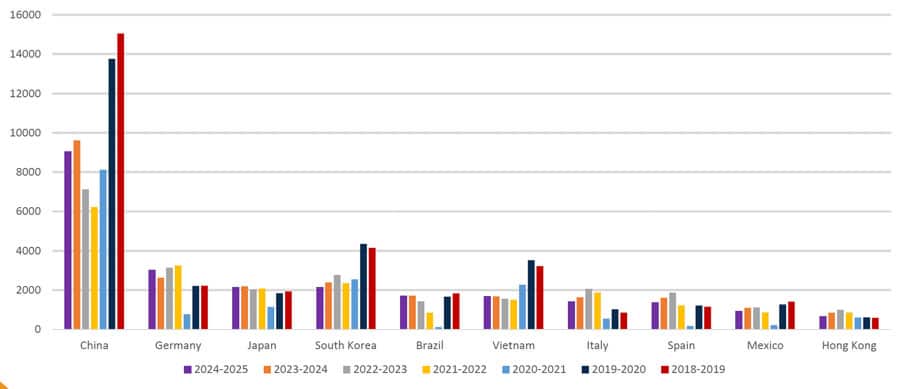
We see a different mix of sending markets for short-term studies. China and Germany remain near the top of the table (5th and 4th, respectively) but after Japan, Colombia, and Spain.
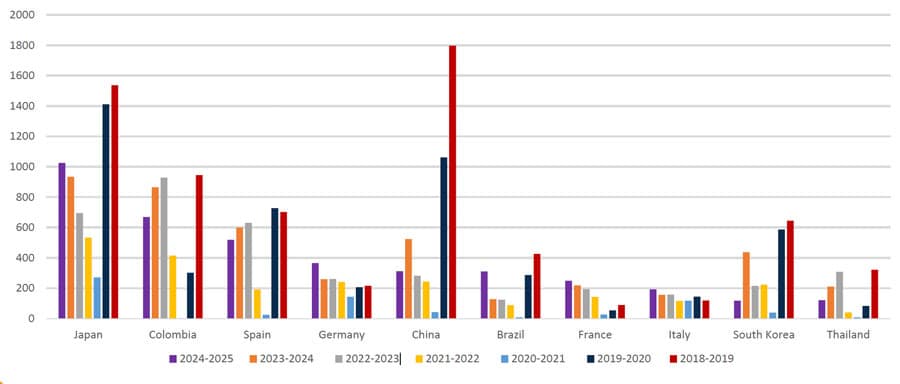
CAPS-I notes a "significant decrease" in the numbers of short-term students from China, South Korea, and Thailand, and also for Mexico and Hong Kong, neither of which remains among the top ten sending markets this year.
For additional background, please see:
- "International schools segment registers impressive five-year growth numbers"
- "ICEF Podcast: Shifting horizons: Global trends in international secondary education"
- "A big-picture view of international student mobility for secondary studies"
- "International enrolment in Canadian K-12 recovered to more than 80% of pre-pandemic levels in 2022/23"
Most Recent
-
Decline in Indian demand a major factor in softer outlook for foreign enrolment in US higher education in 2026/27 Read More

-
Australia: As visa applications from foreign students fall, the government has set the national target for new international students in 2027 Read More
-
Independent K-12 schools in the UK hosting fewer international students this year Read More







