Recruiting in Sri Lanka: Demand for study abroad remains high; TNE poised for further growth




- Overcapacity in Sri Lanka’s tertiary system as well as a volatile economy underlies huge demand for study abroad
- At the same time, the country struggles with brain drain, which is one of the reasons the government is encouraging foreign institutions to partner with Sri Lankan universities through TNE delivery models
- There are only two branch campuses in the country so far, but more are expected
Fast Facts
Population: 22 million
Youth population: 24% of the total
Youth unemployment rate: 25% (2023 estimate)
GDP: US$84.3 billion (2023)
Main economic sectors: Rubber processing; cultivation of tea, coconuts, tobacco, and other agricultural products; tourism; clothing and textiles; and mining.
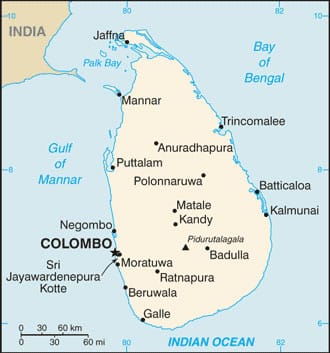
Geography: Sri Lanka is an island nation in South Asia, south of India.
Official languages: Sinhala (spoken in the southern, western and central parts of the country), and Tamil (northern and eastern parts of the island).
Language of instruction: English is introduced alongside official Sri Lankan languages at kindergarten level and then incorporated consistently from Grade 1 in the state school system. In international schools it is the main medium of instruction. The Ministry of Education considers schools that offer all subjects in English to be “English-medium schools.” Those that offer only some subjects in English are termed “bilingual schools.” At the university level, about 80% of courses – especially in STEM – are only taught in English.
Tertiary enrolment rate: 21% (2023)
Literacy rate: 92%, one of the highest in Asia
English language proficiency: Low, according to the EF Proficiency Index
Religions: Majority Buddhist, with 13% percent Hindu, 10% Muslim, and 7% Christian.
Main student cities: Colombo, Kandy, Galle, Jaffna, Trincomalee, Peradeniya, Nugegoda, Moratuwa, Kelaniya, Matara.
Economy: The economy grew by 5% in 2024 – the highest rate in seven years – following a prolonged economic crisis. That expansion beat an Asian Development Bank forecast of 2.4% growth for 2024, helped along by a debt restructuring plan with the International Monetary Fund. Growth was driven by a rebound in the industrial sector – particularly in construction, food and beverage manufacturing, and tourism. Inflation decreased to negative territory. While consumer confidence has been rising, food insecurity is still an issue for many families.
Outbound mobility
Sri Lanka is an increasingly important source of students for institutions all over the world, and it stands out as a hotspot of transnational partnerships, especially with UK universities.
In terms of outbound mobility, the number of Sri Lankan students in Australia grew by 41% between 2019 and 2024 to 19,000. Canada saw a massive jump – 443% more Sri Lankans were studying in Canadian programmes in 2023 than in 2019, for a total of 8,075.
The UK welcomed 5,500 Sri Lankan students in 2022/23 – up by 84% over the previous year and placing Sri Lanka just outside the Top 10 markets for UK universities (#11). Sri Lanka was the fastest growing major market for the UK in 2022/23.
Growth has been more moderate in the US. The 3,420 Sri Lankans in US higher education in 2023/24 represents a 7% increase over 2019.
Japan and Malaysia also host several thousand Sri Lankan students, and China is a major player as well. In April 2024, Chinese ambassador to Sri Lanka, Mr Qi Zhenhong, spoke at a ceremony awarding scholarships to Sri Lankan students at the Chinese embassy in Colombo: “Currently, over 1,200 Sri Lankan students go to China to study with full scholarships, one-time scholarships, and participate in short-term trainings every year.”
Sri Lankan governments are perennially challenged to balance relations with regional powerhouses India and China. There has been growing concern in the country about the scale of Chinese investments and loans to Sri Lanka, leaving the country vulnerable to Chinese influence and power.
Government supports transnational education
Higher education capacity in Sri Lanka is very limited. There are 18 state universities that offer free tuition and residence, and over 350,000 Sri Lankan students participate in A/Level examinations to try to gain entrance. In 2022, of the 172,000 students eligible for acceptance to a state university, only 42,000 students secured admission.
Overcapacity in the public system has led to the rise of private universities. There are now 27 private universities awarding degrees. They can enrol up to 60,000 students – which represents a good deal more capacity than state universities.
The government has made it a priority to expand tertiary access to Sri Lankans – and to encourage more Sri Lankans to remain at home for university studies to avoid brain drain. It actively invites foreign institutions to partner with Sri Lankan universities in offering joint degrees and other collaborative activities. Of the thousands of Sri Lankans enrolled in private universities in their country, a large proportion are studying under a transnational education (TNE) model.
The Sri Lankan government is especially open to foreign universities offering medicine, engineering, business, finance, IT, and AI programmes.
Branch campuses just getting going
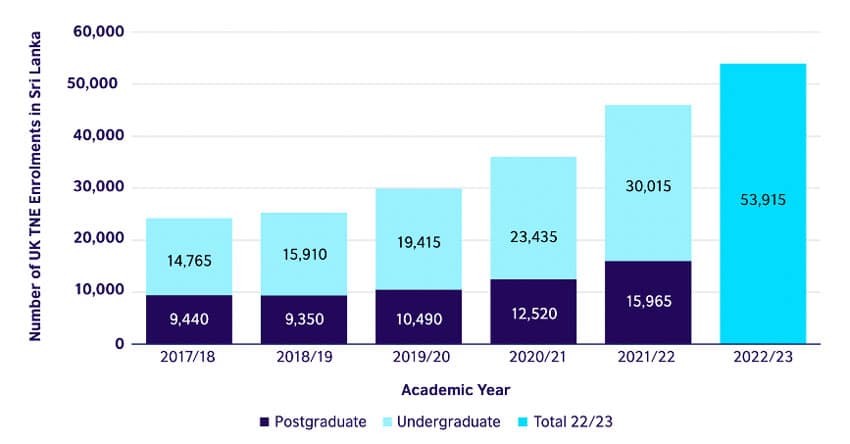
The UK is a major player in TNE in Sri Lanka – as it is in so many other countries. Sri Lankan students make up 10% of all UK TNE enrolments, making Sri Lanka the UK’s second largest TNE market. Interestingly, those enrolments are through UK/Sri Lankan partnerships, not through branch campuses. Of Sri Lankans enrolled in UK TNE, 92% are studying through collaborative provision and 8% are studying via distance/online, according to the British Council.
Forty-four UK institutions have TNE agreements with Sri Lankan universities, as do 22 Australian universities. The UK enrols many more Sri Lankan students than Australia via TNE (over 50,000 versus just over 3,000 in 2022/23, respectively).
As for branch campuses, there are less than a handful in Sri Lanka – so far. At the end of 2024, Perth-based Curtin University launched a campus in Colombo, consisting of purpose-built facilities at the Sri Lanka Institute of Information Technology (SLIIT). Curtin plans to expand the programmes it has been offering for years to Sri Lankan students through other forms of TNE (engineering, computer science, and business studies) to include artificial intelligence, health, and humanities-related subjects.
Curtin University Colombo will also recruit students from India, Bangladesh, Nepal, and the Maldives, and it is set up to allow its students to transfer to Curtin’s other campuses in Australia, Malaysia, Singapore, UAE, and Mauritius.
Curtin is the second Perth-based university to open a branch campus in Colombo. Edith Cowan University launched its campus in 2023 and offers programmes in biomedical science, cyber security, commerce, and more.
India and Sri Lanka have close economic and security ties, and India’s top-ranked engineering institute, the Indian Institute of Technology Madras (IIT Madras), was approved to open a branch campus in Kandy in 2024 (it hasn’t opened yet).
The growing importance of TNE
Sri Lanka has struggled for years with brain drain. It offers free education until the end of high school, but capacity issues in the tertiary system means the Sri Lankan government is not reaping ROI from its students given that so many either fail to gain entrance to a domestic university or leave the country for study abroad, often with a goal of permanent residency in the host country. According to a 2021 Institute for Health Policy Opinion Tracker Survey, 1 in 16 Sri Lankans had plans to migrate, and most of those wanting to leave are young people.
As Sri Lanka’s Daily Mirror reports:
“While about 48 percent of the age group of 18-29 years want to leave the country, about 53 percent of degree holders and 45 percent of A/Level qualification holders desire to migrate. Since the ‘educated youth’ represent the future workforce of a country and are crucial for its long-term progress, increased labour migration has posed a new threat to the country’s development.”
Push factors for Sri Lankan students include corruption, poor job prospects, and low wages.
TNE is an exciting prospect for many Sri Lankan students because it is more affordable and confers a high-quality degree. But a fractured political environment in Sri Lanka and still-fragile economic conditions must greatly improve if more Sri Lankan graduates are to decide to stay in their country to work.
For now, Sri Lankans are tempted by the prospect they see every day on billboards in their city to start their studies at home then move abroad. Last year, in Canada’s Globe and Mail. author Randy Boyagoda wrote:
“’Start in Sri Lanka, finish in Australia!’ These were phrases from just two of the many, many billboards advertising opportunities for international higher education that I saw on Sri Lankan highways and throughout Colombo. I also drove past buildings that housed local offices for overseas universities, and for international university consortiums with local campuses, and for professional agencies promising assistance for students hoping to study in Australia, New Zealand, Singapore, the U.K., Belarus, and yes, Canada. While not nearly as large a source country for international university students as India or China, Sri Lanka clearly was a place of interest in this massive global business.”
For additional background, please see:
Most Recent
-
Breaking: US Department of Homeland Security publishes rule to end Duration of Status for international students Read More

-
Joint sector alert sends a clear compliance message to Australian higher education and VET providers Read More
-
Academic support and learning resources in TNE: Delivering student success across borders Read More