


UK: Home Office data finds a significant drop in student visa applications for first quarter of 2024




- As of January 2024, most international students are prevented from bringing accompanying family members with them during studies in the UK
- This new rule coincides with a 44% drop overall in study visa applications, led by a sharp decrease in the number of applications from accompanying dependants, in the first three months of 2024
The UK’s tightened immigration settings are having a profound effect on international student demand for educational programmes in the UK. In particular, the rule that took effect in January 2024 stipulating that international undergraduates and master’s students cannot bring their dependants is dampening demand from the key student markets of Nigeria and India.
In the first three months of 2024 (January, February, March), the latest data from the UK Home Office shows that 40,700 “sponsored study” visa applications were filed by international students, compared with 72,800 in the same period in 2023 – amounting to a 44% decrease overall.
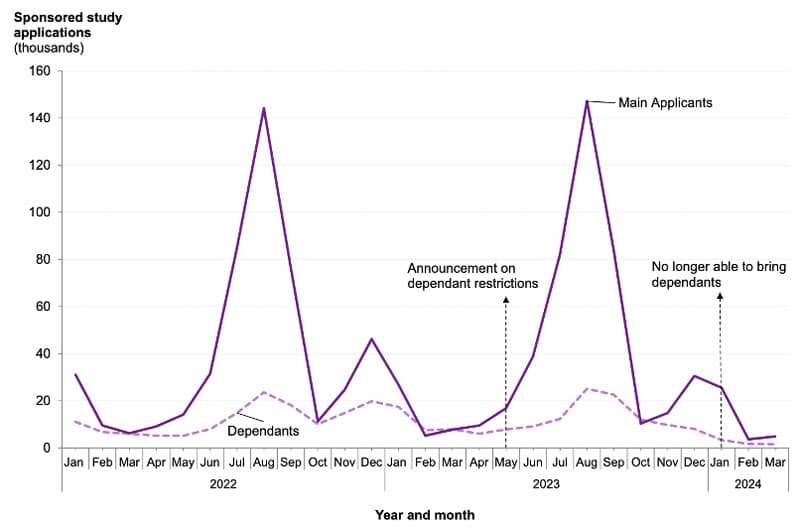
The main driver of the decline is a dramatic fall-off in applications for accompanying dependants. In 2023, there were 39,900 “main applicant” submissions for study visas and 32,900 dependant applications. By comparison, in the same time frame in 2024, there were 34,000 submissions from “main applicants” (-15% from 2023) and only 6,700 for dependants (-80%).
Leaving aside dependant-applicants for a moment, this means that the volume of applications for “main applicants” has declined by just over -27% over the last two years.
The chart below shows the spike in applications from both main applicants and dependants in the months just after the May 2023 announcement of the ban on dependants (other than those attached to students pursuing post-graduate research degrees). The volume of applications then began to fall in September 2023. The “main applicants” volume picked up again in October-December 2023, but not to the same level as in those months in 2022. Dependants’ applications continued to decline through March 2024.
An accompanying statement from the UK Home Office adds that, “It will be necessary to await the peak in student applications for the next academic year (which usually comes in August/September) before we can see the full effect of recent policy changes and any other impacts.”
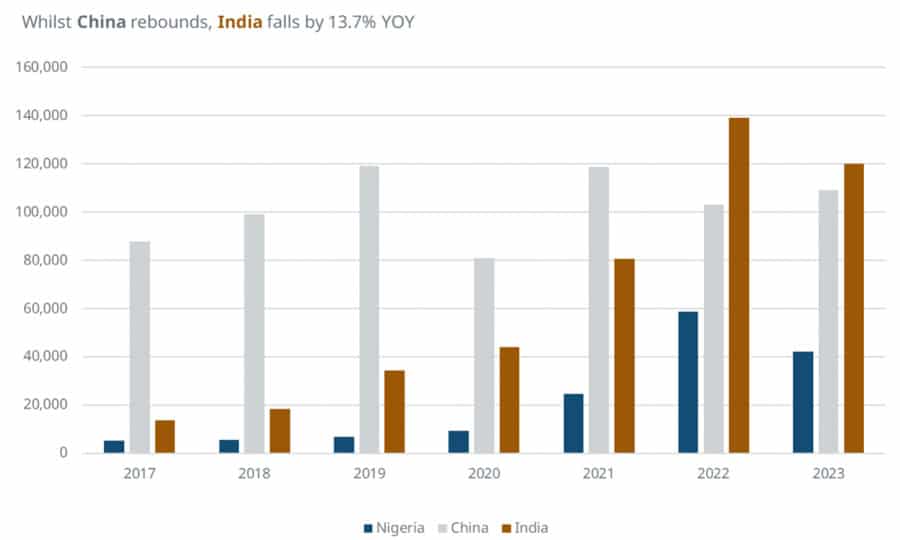
The student accommodation provider Sturents.com reports that according to UK government data, Indian student applications had already slipped by 13% in 2023 and Nigerian applications had plummeted by 63.5%. In contrast, Chinese students submitted more applications in 2023 for study in the UK.
Data from the student enrolment platform Enroly (used by about a third of UK universities) show that the trend of declining Indian and Nigerian demand in 2023 has carried through to this year. For India, universities had issued 34% fewer Confirmations of Acceptance for Studies (CAS) to students in the January 2024 intake compared with the January 2023 intake, and deposits were off by 38%. For Nigeria, CAS issuance was off by 71% and deposits were 22% lower than in 2023.
UK business schools, which deliver so many postgraduate-taught programmes, are also noticing the effects of the dependants ban this year. Just over three quarters (76%) of 50 UK institutions responding to a Chartered Association of Business Schools survey said that their non-EU enrolments had fallen in the January 2024 intake. And a Universities UK survey of 73 member universities found that on average, international student enrolments in postgraduate-taught courses starting in January 2024 were 44% lower than in January 2023.
Robert MacIntosh, Chair of the Chartered Association of Business Schools and Pro-Vice Chancellor for the School of Business and Law at Northumbria University said:
“These latest results show the potential for the government’s immigration policies to severely damage one of the UK’s most successful exports. The decline in international business student enrolments will limit a vital source of universities’ income which underpins the cost of teaching and research across subject areas far beyond business and management."
UK universities are bracing for the results of a government review of the popular Graduate Route, which allows internationals students to remain in the UK for 2-3 years after completing their studies. That review, which intends to examine if the route is being exploited, is due to be released in the next couple of months.
In recent months, international students have also had to face a 65% increase to the Immigration Health Surcharge fee. The fee for health coverage rose to £776 per year in February 2024.
For additional background, please see:
Most Recent
-
Academic support and learning resources in TNE: Delivering student success across borders Read More

-
England: Government “remains of the view” that the International Student Levy should go ahead; implementation planned for August 2028 Read More
-
Decline in Indian demand a major factor in softer outlook for foreign enrolment in US higher education in 2026/27 Read More







