


Market intelligence for international student recruitment from ICEF
13th Jan 2021

Survey measures expectations for higher education delivery in 2025

Short on time? Here are the highlights:
  • A global survey reveals that many believe that online and hybrid learning will play a much greater role in higher education in the years ahead

Globally, one quarter of adults believe that higher education in their country will be conducted entirely or mostly online five years from now. Another half expect that higher learning will mostly take place via a hybrid model that combines online and in-person learning.

These are among the top-line findings of a recent survey conducted by Ipsos and commissioned by the World Economic Forum. The survey ran over October and November with nearly 28,000 respondents from 29 countries.

Online or in person?

Expectations vary considerably from country to country as to whether higher education will be delivered primarily online or in person in 2025.

At the higher end of the scale are Saudi Arabia, India, South Africa, Malaysia, and Australia. Roughly a third to a half of respondents from each of those countries expect that higher education will mostly (or entirely) be delivered online five years from now. Most respondents from Mexico, Russia, China, Argentina, Peru, Japan, South Korea, and Chile said they thought that teaching and learning would mostly take place in person.

As an accompanying note from the World Economic Forum points out, "The majority think the split between online and in-person learning that’s come about during the COVID-19 pandemic is here to stay."
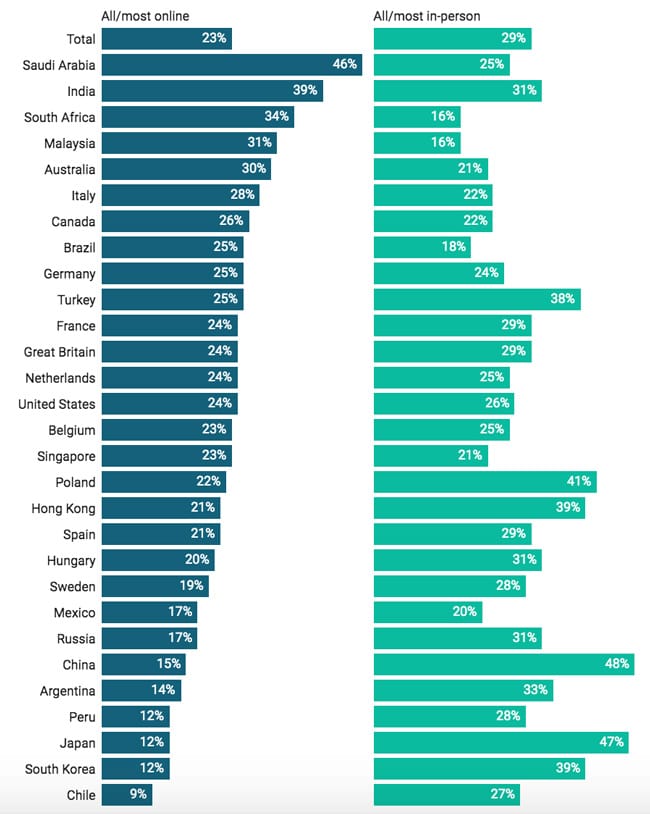
Survey respondents' views, globally and by country, on how higher education will be conducted five years from now. Source: Ipsos

Return on investment

The other major topic addressed in the survey is whether or not in-person higher education (in the respondent's home country) is worth its cost.

Globally, just over half of respondents agreed that the value of in person learning justified the expense, and, as the following chart illustrates, there was again a considerable range from country to country. Those responding from China, Sweden, Saudi Arabia, and India were much more likely to feel that the costs of in person higher education were warranted.

Ipsos adds that, "Globally, men, adults aged 50–74 and, most of all, those with a university degree are especially likely to agree that in person higher education in their country is worth the cost."
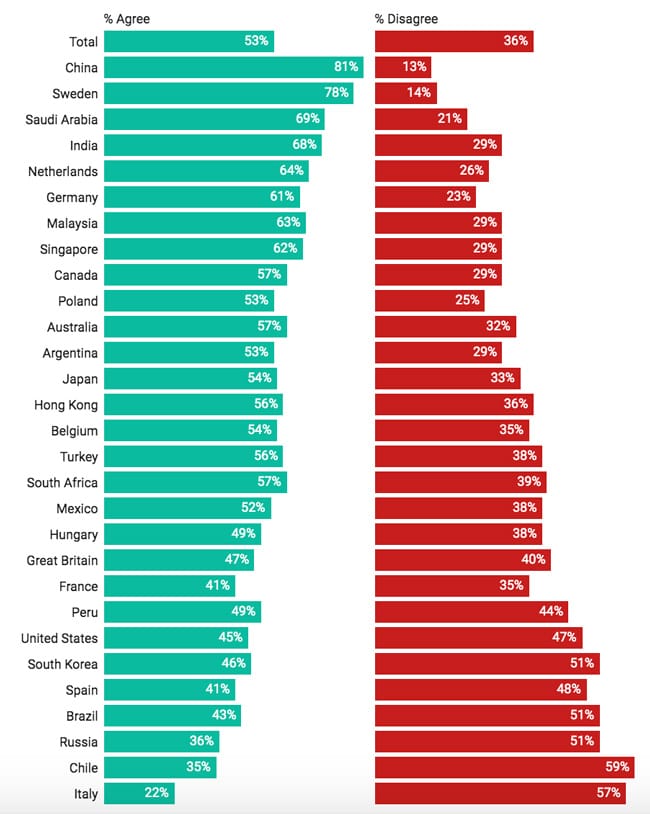
"Is in-person higher education worth its cost?" Source: Ipsos

For additional background, please see:

Most Recent

  • Narrowing bands of compliance: How the UK’s new RAG system will impact international student recruitment Read More
  • Irish higher education reports a fourth straight year of foreign enrolment growth Read More
  • Mexico: A personalised, supportive approach is the key to success in this growing study abroad market Read More

Most Popular

  • Which countries will contribute the most to global student mobility in 2030? Read More
  • Research shows link between study abroad and poverty alleviation  Read More
  • Beyond the Big Four: How demand for study abroad is shifting to destinations in Asia and Europe Read More

Because you found this article interesting

Narrowing bands of compliance: How the UK’s new RAG system will impact international student recruitment The UK Home Office has circulated draft guidance to expand on forthcoming changes to the Basic Compliance Assessment...
Read more
Irish higher education reports a fourth straight year of foreign enrolment growth The number of international students enrolled in Irish universities has been growing steadily from a COVID-era dip in...
Read more
British Council says student recruitment to UK higher education will get a boost this year from South Asia and the “Trump effect” “Demand for UK education will remain resilient over the coming year despite increased competition from intra-regional mobility in...
Read more
New Zealand expands post-study work opportunities for international students In late 2026, New Zealand is rolling out a new Short Term Graduate Work Visa and extending eligibility...
Read more
As Iran retaliates across the Middle East, schools close, students worry, and institutions reassess transnational education The US/Israel-Iran war has touched down in several countries in the Middle East, and international educators and students...
Read more
US: Student visa issuances fell by -36% in summer 2025; OPT uncertainty among factors affecting international student demand The US government has renewed its focus on the Optional Practical Training (OPT) programme that allows international students...
Read more
Canada and India deepen educational ties; India repositions as an equal player in international education As with China in the 2010s, the West is waking up to the reality that India’s “emerging economy”...
Read more
Inbound, outbound, and transnational: the landscape for international education in China continues to evolve China is broadening its approach to international education and talent attraction. The Chinese government continues to support the...
Read more
What are you looking for?
Quick Links