
Market intelligence for international student recruitment from ICEF
7th Aug 2018

Saudi Arabia orders its scholarship students out of Canada

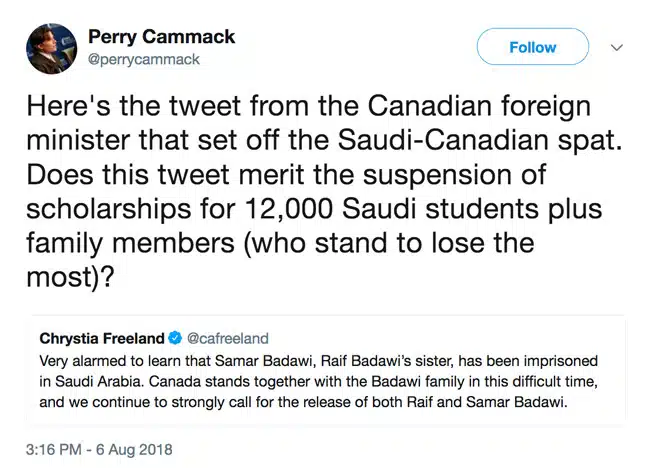
In a move that will disrupt the study programmes of thousands of students, not to mention the fall semesters at many Canadian institutions and schools, Saudi Arabia has ordered its scholarship students to return home from Canada immediately. The announcement will affect all scholarship students currently enrolled in Canada. The Canadian Bureau for International Education reports that there were just under 10,000 Saudi students in Canada as of 2017, and CNN places the number of current scholarship recipients at 7,000. Both of those numbers are down significantly from even a few years ago when the Saudi government began to wind down the massive King Abdullah Scholarship Programme. The remaining scholarship students have now reportedly been advised to plan to transfer to other countries to continue their studies in the coming academic year. The move comes amidst a rapidly escalating diplomatic spat between Saudi Arabia and Canada. The Kingdom has accused Canada of “blatant interference” in its domestic affairs. At issue is a August Twitter post by Canada’s Minister of Foreign Affairs, Chrystia Freeland, which objected to the Kingdom’s recent detention of a Saudi activist. Minister Freeland’s original Twitter post, along with a commentary from Perry Cammack, a fellow in the Middle East Programme at the Carnegie Endowment for International Peace In response, the Saudi government promptly expelled Canada’s ambassador to the Kingdom, and recalled its own envoy from Canada. The government has also said that, effective immediately, it is “freezing of all new trade and investment between the Kingdom and Canada, while retaining its right to take other measures.” Those additional measures now include the suspension of scholarships for Saudi students in Canada, and, as of 13 August, the suspension of all Saudi Arabian Airlines service to Canada. For its part, the Canadian government has affirmed its original statement and questioned the Saudi response. “We are deeply concerned that Saudi Arabia has expelled Canada’s ambassador in response to Canadian statements in defence of human rights activists detained in the Kingdom,” said Minister Freehand. “Canada will always stand up for the protection of human rights, including women’s rights and freedom of expression around the world. We will never hesitate to promote these values and we believe that this dialogue is critical to international diplomacy.” The Saudi government, meanwhile, remains firm in its view that Canada is overreaching in this case: “The Canadian position is an open and transparent interference in the internal affairs of the Kingdom of Saudi Arabia and contrary to the most basic international norms and all the charters governing relations between countries,” said an official statement. “It is a grave and unacceptable transgression against the Kingdom’s regulations and procedures, and in violation of the judicial authority in the Kingdom. Throughout its long history, Saudi Arabia has not accepted and will not accept interference in its internal affairs or impose dictates on it from any country. The Canadian position is an attack on Saudi Arabia that requires a firm stance towards it. The Kingdom of Saudi Arabia expresses its absolute and categorical rejection of the position of the Canadian Government.“
What happens next?

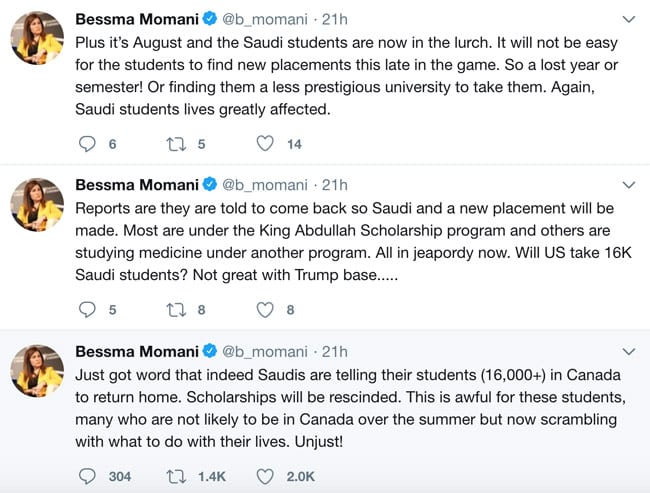
Official government sources from the Kingdom have not yet commented publicly on how current scholarship students will be affected, but the suspension of scholarships has been confirmed via a recent news report on the Saudi-owned Al Arabiya news service, which characterises the decision as a “suspension of training, scholarships, and fellowships to Canada and the transfer all its students in that state to other countries.” An education ministry spokesman has also said, via Twitter, that the government is working on an emergency plan to speed the transfer of students to other study destinations. Canadian educators, along with Saudi students enrolled in Canada, have been left to absorb these latest developments with less than a month to go before the start of the new academic year. Bessma Momani is a professor at the University of Waterloo and an analyst on Middle East affairs. In a series of related tweets from 6 August, she sets out in stark terms the situation for both students and their institutions. A series of Twitter posts from Canadian university professor Bessma Momani Related reports in Canadian media place the number of affected students in the range of 15,000–16,000. However, official figures from Immigration, Refugees and Citizenship Canada indicate the actual number of Saudi scholarship students in Canada this year is less than 8,000. Even so, the economic impact of the move will be measured in the millions of dollars. “For Canadian universities, this is a significant hit,” said Thomas Juneau, an assistant professor at the University of Ottawa’s Graduate School of Public and International Affairs, in an interview this week with the Globe & Mail newspaper. For additional background, please see:
Most Recent

  • Decline in Indian demand a major factor in softer outlook for foreign enrolment in US higher education in 2026/27 Read More
  • Australia: As visa applications from foreign students fall, the government has set the national target for new international students in 2027 Read More
  • Independent K-12 schools in the UK hosting fewer international students this year Read More

Most Popular

  • Which countries will contribute the most to global student mobility in 2030? Read More
  • Research shows link between study abroad and poverty alleviation  Read More
  • Beyond the Big Four: How demand for study abroad is shifting to destinations in Asia and Europe Read More

Because you found this article interesting

Decline in Indian demand a major factor in softer outlook for foreign enrolment in US higher education in 2026/27 The Institute of International Education (IIE) does a twice-yearly snapshot survey of US institutions that required reading in...
Read more
Australia: As visa applications from foreign students fall, the government has set the national target for new international students in 2027 The Australian government has announced overall settings for “managing the growth” of the country’s international education sector for...
Read more
Independent K-12 schools in the UK hosting fewer international students this year Independent (private) K-12 schools belonging to the Independent Schools Council (ISC) are hosting 57,200 non-British students in the...
Read more
US regulatory agenda for 2026 aims to end “duration of status” and introduce Optional Practical Training and H-1B reforms On 6 July 2026, departments across the US federal government published a unified regulatory agenda for the year...
Read more
China in 2026: Slowing outbound student mobility, accelerating inbound momentum The number of international students studying in China is quickly catching up with the number of Chinese students...
Read more
Surprise hike in international student visa application fees “a direct hit to Australia’s competitiveness” Australia’s international education sector is reeling at new study, work, and working-holiday visa application fees for international students...
Read more
ICEF Podcast: “Good, steady, and disciplined”: New Zealand’s plan for sustainable international enrolment growth Listen in as ICEF’s Craig Riggs and Martijn van de Veen recap some of the latest developments in...
Read more
OECD: International students may be underinformed about job prospects in top destinations For many students from emerging markets in Asia, Africa, and Latin America, there is a dream pathway attached...
Read more
What are you looking for?
Quick Links