Indian engineering graduates held back by limited English




A new study finds that poor English-speaking skills are limiting the employment and earning prospects of India’s engineering graduates. India produces roughly 600,000 engineers each year. While many are taught in English and can read and write the language, a survey of 30,000 engineering students across 500 institutions finds that only 2.9% speak English at a level required for the best jobs in software development, sales, or consulting. More broadly, nearly 67% of the engineers graduating from India’s universities and colleges lack the level of spoken English necessary to compete for a job in the country’s burgeoning knowledge economy. The survey, The National Spoken English Skills of Engineers Report, was released recently by Aspiring Minds, a leading talent assessment company with offices in India, the US, China, the Philippines, and the UAE. The survey was conducted by telephone using Aspiring Minds’ proprietary test of spoken English, the SVAR. During testing, only 6.8% of engineers demonstrated the ability to speak or respond spontaneously. Pronunciation was the major problem identified via the SVAR, followed by fluency, grammar, and sentence construction. Respondent performance was somewhat better with respect to vocabulary and listening comprehension. The Times of India reports that the minimum English proficiency required for top entry-level positions in software and business consulting is equivalent to C2, or the highest level of the Common European Framework of Reference for Languages (CEFR). "With jobs going global, the importance of English has increased [many times over]," agrees Varun Aggarwal, Co-founder and CEO of Aspiring Minds. "It is now a medium of communication at both international and intra-national levels.
"However, at the same time, it is disappointing to know that 97% engineers cannot speak English fluently and three quarters of them are not eligible for job requirements in any knowledge economy."
"Recruiters and HR managers around the world report that candidates with English skills above the local average stand out from the crowd and garner 30-50% higher salaries than similarly qualified candidates without English skills. The trends in India are no different, with English fluency being one of the key qualities recruiters look for during the interview process."
Across the spectrum
Issues of limited proficiency in spoken English were found across the higher education spectrum in India, including at the country’s top-ranked institutions for engineering studies, the Indian Institutes of Technology (IITs) and National Institutes of Technology (NITs).
"We get students from different backgrounds and regions, and they are mostly not comfortable with English," said Gautam Biswas, Director of IIT Guwahati. "Quite a few students appear for the joint entrance examination in their mother tongue. It becomes very difficult for them to follow the curriculum."
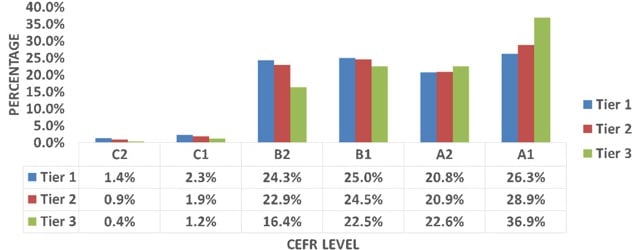
However, the study did find a correlation between English proficiency and tier of institution, with students at lower-tier colleges more likely to struggle with spoken English.
Shifting the curriculum
The study has raised new questions about the curriculum in secondary school and higher education, and the extent to which India’s colleges need to place a greater focus on so-called "soft skills," including language proficiency. "While the curriculum continues to be in English, students are not encouraged to converse in English right from school level," says Mr Aggarwal. "The emphasis has always been on understanding and writing English but hardly on spoken skills." UB Desai, Director of IIT Hyderabad, agrees and recently told The Economic Times that the strong STEM focus in Indian institutions has crowded out skills development in other areas: "Over the years, the focus in the education system has shifted to chemistry, maths, physics, [and the] focus on soft skills has reduced."
More language training needed
Some institutions, including the NITs, are now taking steps to strengthen language skills development through bridge courses and other supports for incoming students. It is increasingly clear, however, that much remains to be done in order to raise the level of English for Indian graduates. Such findings continue to reinforce projections for a dramatic increase in India’s English Language Training (ELT) market. We reported earlier this year on one forecast indicating the country’s ELT market would grow to US$4.67 billion this year from US$2.76 billion in 2012. This surge in demand is being fueled in part by research indicating that Indians who speak English fluently earn up to 34% more than those with more limited language skills. Certainly these findings are driving growth in ELT in India today, but they are also expected to open up new opportunities for both Indian and foreign providers to play a greater role in strengthening school and higher education curriculum and to deliver expanded language training to close this key skills gap for Indian graduates.