
US: Student visa issuances fell by -36% in summer 2025; OPT uncertainty among factors affecting international student demand




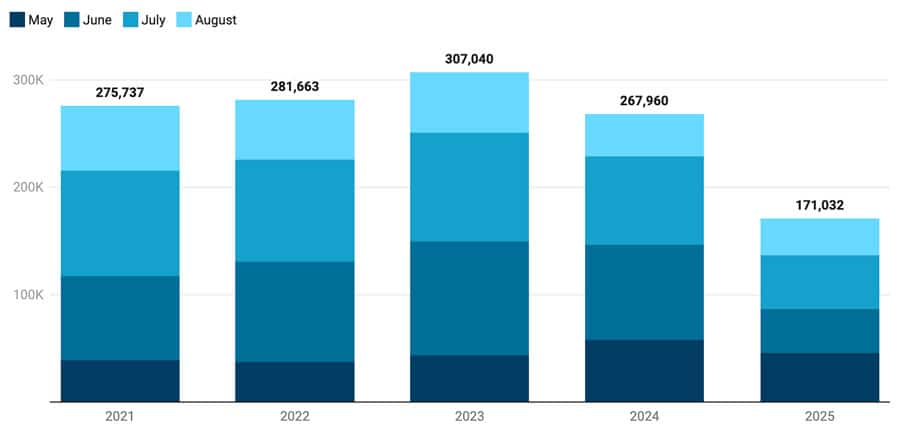
- US Department of State data on F-1 visas shows dramatic declines in issuances to international students in the summer of 2025
- About 60% fewer F-1 visas were given to Indian students between May and August of 2025 than in the same period in 2024
- India is the top source of international students for US colleges and universities
- Visas fell significantly for students from other major markets as well
- A pending proposal to restrict or terminate the OPT work programme for F-1 students may have a profound impact on demand for study in the US
- OPT – especially the three-year version for STEM students – is a key draw for students from Asia
- India and China account for 53% of all international students in the US, and more than half of the top 20 markets for US institutions are Asian
The US government has renewed its focus on the Optional Practical Training (OPT) programme that allows international students on F-1 visas to gain post-study work experience for one to three years following their studies. Before Secretary of Homeland Security Kristi Noem was replaced in her role on 5 March, she responded favourably to Senator Eric Schmitt’s November 2025 letter calling for OPT to be reformed or ended.
"DHS has indicated it intends to re-evaluate practical training regulatory requirements for foreign student visa holders through a rulemaking," said the Secretary. "The rule would propose to amend existing practical training regulations to protect US workers from being displaced by foreign nationals, address fraud and national security concerns, and enhance the Student and Exchange Visitor Program's capacity to oversee the program."
The momentum for a rule change stems from a belief in some circles that the current OPT framework takes jobs from US workers, among other assertions. (Several research studies have found the exact opposite to be true.)
Recent F-1 visa data suggests that OPT’s possible termination is already having an effect on international student demand for study in the US – especially in some of the most important overseas markets for US institutions.
A strategic pillar of US recruitment
The OPT programme is increasingly popular – especially because STEM students can receive a total of three years of work due to their specialisation (regular OPT allows for only one year). Participation in the STEM OPT stream grew +54% in 2024/25 compared with the previous year.
According Mirka Martel, the Institute of International Education’s (IIE) head of research, OPT is an “essential component of an international student’s academic experience" (which is why the organisation includes OPT numbers in its annual Open Doors report on international student numbers in the US). Keystone Education Group research suggests that OPT may be the “strategic pillar and key stabiliser of US recruitment.” The firm found that 86% of international prospects consider staying in the US and working after graduation.
Visas plummet -36%
Leading up to the 2025/26 intake for US institutions, a series of events disrupted international student recruitment. The Trump administration suspended visa interviews at US consulates in May 2025, which lasted for almost a month; revoked thousands of student visas; and it warned of upcoming policies to curb the duration of student visas and post-study rights for international students. In the key summer recruiting window, President Trump also revived the travel ban preventing nationals of some countries from entering the US (and then extended it in December 2025 to 39 countries).
Alongside those events, F-1 visas plunged by -36% between May and August of 2025, according to a Chronicle of Higher Education analysis of US Department of State data.
The top market for US institutions – India – decreased much more sharply than the average: about -60%, which equates to only 22,870 new F-1 visas awarded to Indian students in those summer months. In July and August alone, the drop was nearly -80%.
Why STEM OPT is so important to international students
Of all the disruptive factors spurring the visa declines, uncertainty around the OPT programme – especially STEM OPT – could have the most significant long-term impact on international student demand – particularly in price-sensitive student markets.
The importance of STEM OPT for the families of thousands of international students can be summed up in three letters: ROI (return on investment).
This is because:
- STEM OPT participants must be paid by their employer (this is not a rule for general OPT).
- This means that at least two of the three years of work that STEM OPT participants engage in are paid.
- The three-year term of STEM OPT gives participants three chances to enter the H-1B visa lottery (one per year) – versus one chance offered by a one-year OPT term.
- The H-1B visa, which allows US employers to temporarily hire foreign workers for specialty occupations (mostly in STEM), is valid for three years with a possible three-year extension. Those who receive an H-1B have a better chance to become permanent residents because they gain work experience that counts towards eligibility.
STEM OPT participants' paid work in a specialised STEM field allows them to offset the cost of their degree. The potential ROI increases even further because STEM OPT students have a better chance of receiving an H-1B visa than other students given the multiple times they can enter the lottery.
As Keystone Education Group has written, “The calculation is straightforward: three years of US work experience can be transformative for career trajectories and provides multiple opportunities to secure H-1B sponsorship.”
What is at stake
The following data – which shows the link between international students' demand for STEM studies in the US and the availability of OPT – foreshadows how devastating a restriction or termination of this post-study work stream could be for US universities and colleges :
- Previous research has found that nearly three-quarters of international student graduates in the US use their OPT work benefit.
- In 2024/25, more than half (57%) of all international students in the US were pursuing STEM degrees, rising to 64% at the graduate level. This means that more than half of all international students in the US are eligible for STEM OPT.
- Indian students, who compose 31% of all international students in US universities and colleges, are overrepresented in STEM fields. Indians also make up nearly half (48%) of all students in the OPT STEM stream. Chinese students, who make up the next largest share of international students in the US, are the second largest nationality in STEM OPT: 21%. Without STEM OPT, the idea of paying for a STEM degree in the US would hold less appeal for Indian and Chinese students, especially given cuts to major research programmes by the Trump administration.
- Vietnam, Nepal, and Nigeria are some of the fastest-growing international student groups in the US (growing +49%, +16%, and +9%, respectively, in 2024/25 compared with 2023/24). They are also the among the top 10 nationalities in the OPT programme. US institutions are increasingly reliant on these markets as a counter to over-reliance on China and India.
What is already happening
In our own analysis of US State Department data, we found that India is but one of many student source markets for which F-1 visa issuances are tanking. In July and August of 2025, F-1 visa grants fell by -78% for India, -33% for China, -17% for Vietnam, -83% for Nepal, and -63% for Nigeria. As noted earlier, international students from these countries account for a large share of STEM OPT participants.

OPT = ROI
In July of 2025, the Times of India offered a succinct analysis of what the removal of OPT would mean for Indian students:
“Let’s be clear—it will hurt Indian students. OPT is their runway to repay loans, gain experience, and build global careers. Estimates suggest that the average Indian student spends $60,000–$100,000 on a US STEM degree. Without OPT, the ROI vanishes.”
The Times continued: "Without OPT, US universities become overpriced diplomas without job prospects. Why would anyone pay $100,000 for a degree that ends in deportation? NAFSA estimates international students (led by Indians) contribute $33 billion to the US economy. Kill OPT, and watch that cash vanish."
Effects on domestic students, institutions, and workers
The bulk of international students in the US pay tuition fees that are two to three times higher than domestic fees – and those fees are essential for many institutions to keep STEM programmes running and research facilities competitive with those in Europe and Asia. Remembering that international students make up 54% of US master's enrolments and 44% of doctoral enrolments in STEM fields, and that OPT is a major reason for those high proportions, the declines we would see if OPT were actually removed would be even more drastic than what happened in the summer of 2025. All students would feel the impact.
The end of STEM OPT would also severely disrupt the hiring ability of major tech companies and scientific organisations in the US, making it more difficult for them to maintain innovation levels. A recent Forbes magazine article featured Madeline Zavodny, an economics professor at the University of North Florida, who examined nearly a decade of data on Optional Practical Training. She concluded:
“The results indicate that the OPT program does not reduce job opportunities for American workers in STEM fields ... a larger number of foreign students approved for OPT, relative to the number of U.S. workers, is associated with a lower unemployment rate among those U.S. workers.”
Longer-term impacts
"Brain Freeze: How International Student Exclusion Will Shape the STEM Workforce and Economic Growth in the United States," an October 2025 working paper by researchers Michael Clemens, Jeremy Neufeld, and Amy Nice, analysed different scenarios that could play out according to specific levels of decline in the number of international STEM graduates in the US. According to the "plausible" scenario of a one-third reduction in US-trained foreign graduates:
"There would be 6 to 11 percent fewer high-skill STEM workers in the U.S. workforce overall (including both foreign-born and domestic STEM workers). The best available economic research implies that, within ten years, this one-third decline in foreign STEM graduates from U.S. universities would lead to long-run GDP losses of $240 to $481 billion each year."
For additional background, please see:
- "US proposes new rules for student visas including term limits and other restrictions"
- "US: Study estimates that changes to international student policies could reduce GDP by up to US$481 billion per year"
- "There were more international students in the US than ever in 2024/25 but commencements are declining"
- "Canada and the US are losing international student enrolments to Europe and Asia"