
New Zealand’s international student numbers climbing amid strong public support




- New Zealand now hosts more than 83,000 international students
- All education sub-sectors welcomed more foreign students than in 2024
- China is the top origin market, followed by India
- Nepal and Sri Lanka are growing fast
- More than three-quarters of New Zealanders support maintaining or increasing international student numbers
International student enrolments are rising in New Zealand alongside broad public support for internationalisation in education. Between January and August 2025, New Zealand providers hosted 85,535 international students (+14% over the same period last year). This number is already higher than the full-year total in 2024, and all sub-sectors experienced growth.
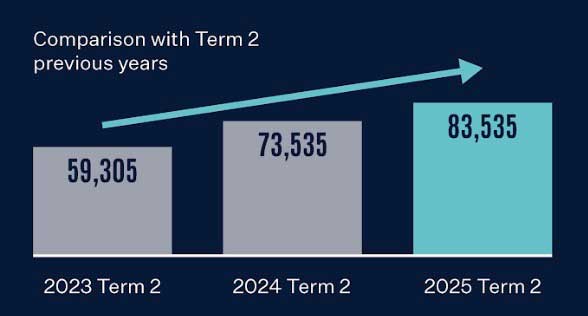
Robust growth in schools, universities, and private training establishments (PTEs)
Universities enrol the most international students (36,045) and hosted 15% more students in Jan–Aug 2025 as in the same period in 2024. Schools enrol the next largest segment (18,505) and are up +10% over last year. The most growth happened within government-funded private training establishments (PTEs), where a +33% uptick brought total numbers for these institutions to 12,060. English-language providers experienced a +7% increase to 7,570 international students in Jan–August 2025.

China remains the most important source market
More than a third (35%) of international students in New Zealand are from China, and 14% are from India.
There are now close to 30,000 Chinese studying in New Zealand (+4% over last year following +19% growth in 2023 and a +17% rise in 2024). There are nearly 12,000 Indian students – a stable number from 2024 after two years of high growth (+99% in 2023 and +49% in 2024). Most Chinese study in universities, while Indians are more evenly divided across New Zealand’s vocational and higher education sub-sectors.
Japan accounts for the third largest share of international students in New Zealand (8%), though numbers are down in 2025 (-9%) after a phenomenal jump in 2023 (+291%) and +11% growth in 2024.
Rounding out the top ten are Sri Lanka, South Korea, the US, Germany, Nepal, the Philippines, Thailand, and Vietnam.

Sri Lanka and Nepal are becoming more important international markets for New Zealand educators. Sri Lanka moved from 9th to 4th, and Nepal moved from 11th to 8th. In 2023, year-over-year growth from Sri Lanka hit +98%, and then +97% and +32% in 2024 and 2025, respectively. Nepal has surged even more: +180% in 2023, +127% in 2024, and +52% in 2025. In 2022, there were only about 250 students from Nepal; now, there are close to 2,500.
Sustainable growth is the goal
Education New Zealand (ENZ) Chief Executive Amanda Malu said,
“Our steady growth shows the sector is resilient and competitive as we move at pace to deliver on the International Education Going for Growth Plan. We are not chasing numbers at any cost, we are focused on sustainable, balanced growth that benefits our regions, strengthens our economy, and adds value to our communities.”
Measured growth leads to economic returns and public license for internationalisation
Ms Malu also said:
“This growth is not only an academic success story, but also an economic one. International students contribute substantially to local communities and the national economy, reinforcing the international education sector’s role as a cornerstone of New Zealand’s global engagement strategy.”
Stats NZ data show that education-related travel exports reached NZD$4.5 billion in 2025 (up to September). This is up from NZD$3.6 billion in the year ended December 2024. International education is one of New Zealand’s top 10 export sectors, contributing 13.6% of all services exports.
The New Zealand public appears to be satisfied with the sector’s approach to internationalisation. In ENZ’s latest 2025 Public Perceptions of International Education Survey, more than three-quarters (77%) of surveyed New Zealanders said they want to see the same or more international students in the country. This compares to about half of Australians and Britons who feel the same way.
Commenting on the ENZ survey findings, Ms Malu said: “It’s absolutely fantastic to see New Zealanders continue to back international students so strongly year after year.”
For additional background, please see: