Both Russia and Japan moving to intensify international student recruitment in Africa




- The Study in Russia campaign in Africa represents a dramatic ramping up of Russian recruitment in the region
- Japan is also focusing more on African recruitment
- As it becomes more difficult for African students to obtain study visas to Western destinations, those students are considering other options
In tandem with shifting geo-political spheres of power, Africa is becoming a priority student recruitment region for Russia. Japan, too, is focusing more intently on African markets in an effort to invigorate its quickly ageing labour force.
Russia: Easier access and better fees
A new campaign organised by the Russian state universities group, Racus, is promising African students a range of benefits not commonly offered by Western universities. According to University World News, the “Study in Russia” campaign emphasises low tuition fees (US$2,000 to US$4,000 a year) and the availability of English- and French-taught degree programmes offered by the association’s 20 university members.
The campaign is also distinctive in that it promises guaranteed (1) admission to African students, including for medical and engineering programmes and (2) student housing for the length of a programme.
A weakening competitive offer from the West
In contrast to Russia, rejection rates of African students’ visa applications are notoriously high in the West.
US: Research conducted by Shorelight and the Presidents’ Alliance shows that 54% of African students were refused an F-1 visa in 2023, up from 44% in 2015. Shelley Landry, senior director of government affairs at Shorelight, said: “This report makes it abundantly clear that the high rate of visa denials in Africa and the Global South is contributing to a loss of share of international students to global competitors.”
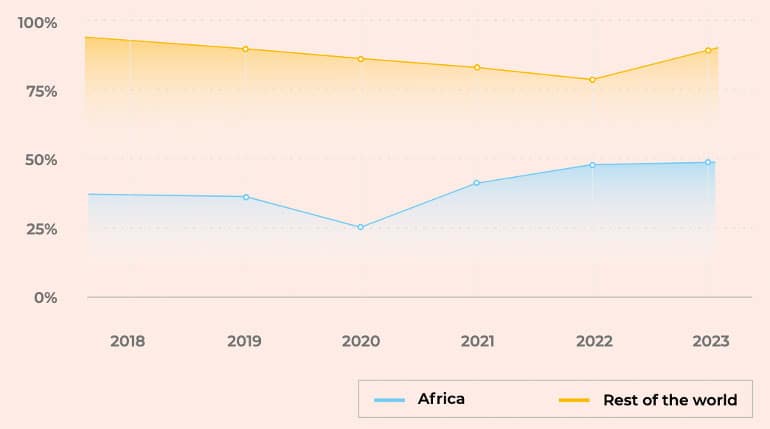
Canada: More than half of African students were denied a study permit in Canada in 2023,
according to an MPOWER report published in June 2024. Strikingly, and as shown in the chart below, less than half of African postgraduate students’ applications were approved in 2023, “in contrast to over 80% approval rates from non-African students.”
UK: Visa approval rates are not excellent for African students in the UK, either. For example, while demand from Kenya is rising quickly, Enroly notes that Kenyans with confirmed offers of acceptance (CAS) on its platform were much less likely to be approved than other students: “Kenya’s refusal rate against CAS issued stood at 6.99%, compared to India (1.88%), Bangladesh: 5.52%, and Pakistan: 4.65%.”
Meanwhile, the dependants’ ban that came into effect in January 2024 has drastically reduced demand from Nigerian students to study in the UK. Nigeria had been a fast-growing market for UK educators before the ban.
“Study in Russia” is a top-level government priority
The Study in Russia campaign dovetails with Russia’s renewed efforts to establish more influence in Africa. In February 2025, for example, Russia’s foreign minister Sergey Lavrov announced the launch of the Department for Partnership with Africa in Moscow. Mr Lavrov heralded Russia’s “return” to Africa and explained the reasons that Russia had withdrawn from Africa in the first place. These given reasons were not surprisingly anti-Western in their orientation and included Russia’s “mistaken” belief that it would be embraced by the West after the dissolution of the USSR.
Japan promotes in-demand programmes for African students
Meanwhile, Japan has its own plan: the Study in Japan for Africa programme. Supported by Japan’s Ministry of Education, Culture, Sports, Science and Technology (MEXT) and spearheaded by Akita University, the plan aims to recruit African students to Japanese universities to programmes in artificial intelligence (AI), biotechnology, environmental studies, information technology, and robotics, as reported in University World News.
Japan is working closely with African universities including Kenya-based Jomo Kenyatta University of Agriculture and Technology (JKUAT) to promote scholarship opportunities in Japan. JKUAT’s engineering and technology programmes enjoy a good reputation and are seen as “an ideal bridge for African students seeking higher education in Japan.”
Japan will set up regional recruiting offices in Botswana and Kenya in April 2025. Currently, there are less than 2,000 African students in higher education institutions in Japan, but the plan is to increase this to 2,500 by 2028.
In 2022, according to the World Economic Forum, almost half of Japanese firms relied on workers over the age of 70. In 2023, former Prime Minister Kishida told lawmakers in the country that "Japan is standing on the verge of whether we can continue to function as a society” as a result of its falling birthrate and elderly population.
What of France?
France remains the top enroller of African students, and most of its top African markets are continuing to grow. The exception is Morocco, which was down -4% in 2023/24 versus the previous academic year. Here is a rundown on African enrolments in France in 2023/24:
- Morocco: 43,350 (-4%)
- Algeria: 34,270 (+7%)
- Senegal: 16,955 (+11%)
- Tunisia: 15,255 (+7%)
- Cote d’Ivoire: 11,770 (+10%)
- Cameroon: 10,880 (+11%)
While France has tried to diversify its international student population to rely less on African enrolments, slower growth in 2022/23 from Asia underlined the importance of a continued focus on Africa.
For additional background, please see:
Most Recent
-
Breaking: US Department of Homeland Security publishes rule to end Duration of Status for international students Read More

-
Joint sector alert sends a clear compliance message to Australian higher education and VET providers Read More
-
Academic support and learning resources in TNE: Delivering student success across borders Read More