Canada’s language training sector reached 82% of pre-pandemic benchmark in 2023




- The post-pandemic recovery for Canada’s language training sector continued last year, with growth across a variety of sending markets and especially so in Latin America
- However, the sector continues to be hampered by visa processing delays and by immigration policy in general
Canada's language training sector continued its recovery from the pandemic in 2023. A new annual report from Languages Canada, produced by industry research specialists BONARD, finds that Canadian language programmes – both English and French – enrolled a combined 112,564 students last year and delivered 1,234,447 student weeks of instruction.
That 2023 volume equates to 75% of pre-pandemic student numbers and 82% of pre-COVID student weeks. Just over nine in ten of those student weeks (92%) were for English-language learning, with the balance for French. Just over 80% of that total (83%) were delivered by private providers, with the remaining 17% delivered by language programmes operated by public institutions.

Nearly two-thirds (63%) of all student weeks were delivered via in-person instruction in 2023, with another 30% given online (whether for students in Canada or abroad). The final 6% of student weeks relied on a hybrid delivery model.
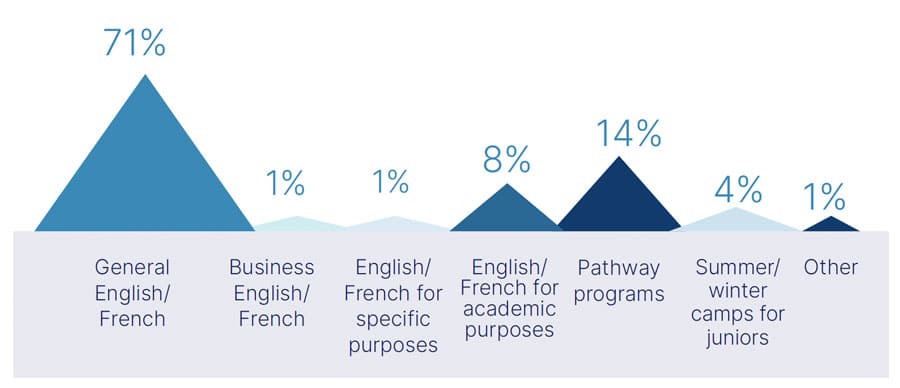
As we see in the outline below, the majority of students were enrolled in general language studies, pathway programmes, or academic preparation courses.
Where do students come from?
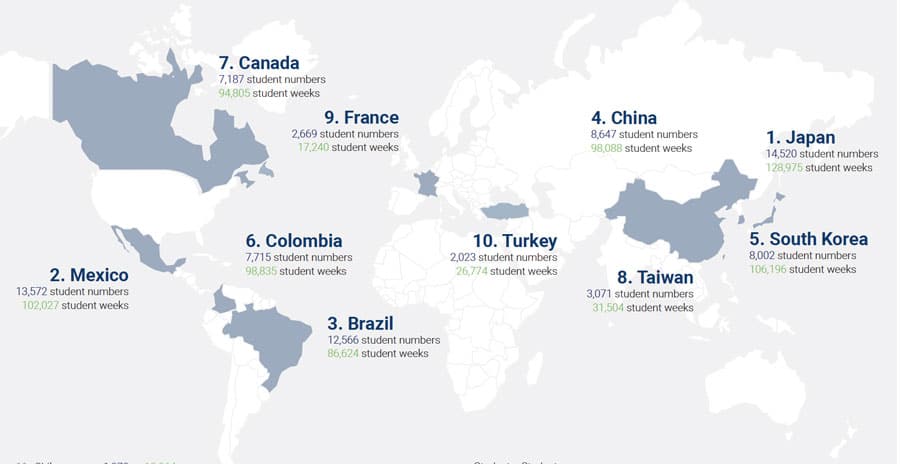
More than three in four languages students in Canada (76%) come from either Asia or Latin America. The following infographic highlights the top ten sending markets for 2023. All of those top sending countries recorded year-over-year growth in 2023, with the exception of Colombia, which declined by -6%.
Visa status and visa challenges
The following chart indicates that many students attended a Canadian language programme with a visitor visa ("eTA" or electronic travel authorization in the legend below). But significant numbers also travelled to Canada under a study permit or temporary resident visa.
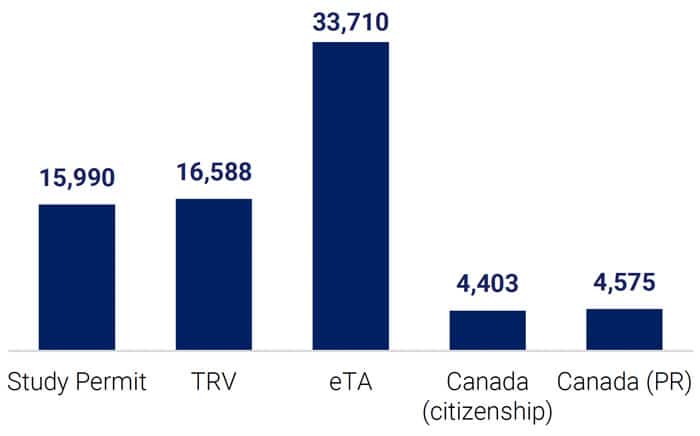
The report adds that, "In 2023, the fastest-growing visa category was the Temporary Resident Visa (TRV). The number of students entering Canada through the TRV route increased from 8,559 in 2022 to 16,588 in 2023, surpassing pre-pandemic levels. This also caused a drop in the average course duration seen predominantly in the private sector. On the other hand, the number of students on study permits decreased from 17,191 in 2022 to 15,990 in 2023 due to issues with visa processing and refusals."
As we have seen in other destinations this year, however, Canadian language schools report that visa issues prevented thousands more students from pursuing their studies in 2023. The report estimates that at least 2,671 students were not able to travel to Canada as planned due to processing delays for temporary resident visas, and that a further 4,479 students were not able to travel due to study permit delays.
This means that visa processing issues disrupted the travel plans for a minimum of 7,150 language students in 2023 – a number equivalent to 7% of the total enrolment for the year. Commenting in a foreword to the report, Languages Canada Executive Director Gonzalo Peralta said, "In 2019, Canada’s language programmes generated CDN$6.7 billion and 75,000 jobs, mostly derived from export revenues. In 2023, that figure decreased to CDN$5.5 billion and 62,000 jobs. This drop was not due to lack of opportunity, promotional efforts, or support from some areas of government, but was primarily due to immigration policy."
For additional background, please see:
Most Recent
-
Breaking: US Department of Homeland Security publishes rule to end Duration of Status for international students Read More

-
Joint sector alert sends a clear compliance message to Australian higher education and VET providers Read More
-
Academic support and learning resources in TNE: Delivering student success across borders Read More