New Zealand’s international enrolment continued to recover in 2023




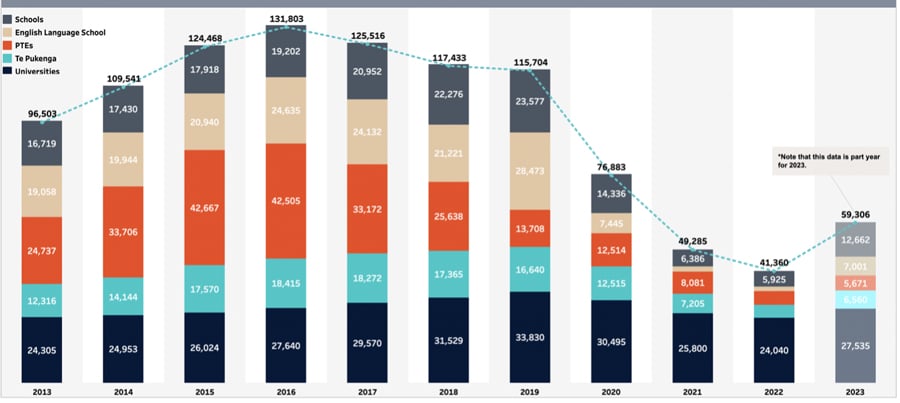
- New Zealand has yet to release full-year data for 2023, but in the first eight months of that year, international student numbers were up 43% compared with all of 2022
- That partial-year data represents nearly 52% of pre-pandemic enrolment levels from 2019
- The English-language sector contributed the most growth, with 347% more students enrolled
- About half of international students in the country are enrolled in universities
New Zealand’s international education sector welcomed significantly more students in 2023 than in 2022, according to data released by Education New Zealand and announced last week by Penny Simmonds, Minister for Tertiary Education and Skills, Penny Simmonds. There were 43% more international students in New Zealand in the first eight months of 2023 than students counted in all of 2022. Full-year data for 2023 will be announced soon.
English-language training sector posts big gains
In total, 59,305 students were enrolled across all sectors from January-August 2023, about half of whom were attending university (27,535, up 15% on 2022). The second largest subsector was schools, up 114% to 12,660, followed by the English-language training sector, which posted massive growth of 347% for a total of 7,000 students.
The strengthening performance of the ELT sector is a positive indicator of future trends for universities and other tertiary-level educators, as many ELT graduates go on to enrol in higher education having achieved a stronger command of the English language.
Numbers were also up by 32% to 6,560 for Te Pūkenga, a centralised establishment specialising in skills and technology training that is in the process of being “disestablished.” It will be replaced with eight to 10 institutions with their own autonomy in the next several months with an aim of better serving the needs of local communities.
Private Training Establishments (PTEs) recorded growth of 13% to 5,670.
Recovery still underway but the trend is positive
Overall, numbers are still down significantly from 2019 when the total foreign enrolment in the country was 115,705, but the trajectory is positive and New Zealand educators are aiming to base their recovery on recruiting from a more diverse mix of student source markets.
Minister Simmonds said:
“Over 59,000 enrolments, in just eight months, confirms that international students continue to find New Zealand an attractive education destination. And for the university sector with 27,535 students enrolled, where a proportion of learners may study for a number of years, there is a solid base of students from which to grow. It is a Government priority to diversify our recruitment efforts for international students with the aim of reaching a broader spectrum of countries.”
Currently, China contributes 36% of enrolments, followed by India (10%), Japan (10%), South Korea (5%), and Thailand (4%).
New Zealand’s position strengthens amid weakening demand for Australia, Canada, and UK
The recovery of New Zealand’s international education sector may be bolstered by policy changes in leading competitor countries Australia, Canada, and UK. New policies in those countries are already causing many international students to reassess their study plans. Nearly half of 2,500 prospective students in 67 countries surveyed by IDP in January 2024 are reconsidering or unsure of their plans to study in the UK, and significant proportions are also hesitating to go to Australia (47%) and Canada (43%).
For additional background, please see:
Most Recent
-
Why sharper English-language guidance is becoming an agent’s sharpest tool for student success Read More

-
Breaking: US Department of Homeland Security publishes rule to end Duration of Status for international students Read More
-
Joint sector alert sends a clear compliance message to Australian higher education and VET providers Read More