


US: New survey shows international student recruitment shifting to India in 2023




- New IIE research indicates that US universities and colleges are prioritising India more than China now as a source of students
- Other growth markets are also very much on the radar for 2023/24
- A strong majority of US higher education institutions report that international applications for the 2023/24 academic year have increased (for the second year in a row)
The IIE’s Spring 2023 Snapshot on International Educational Exchange suggests that, in preparing for the 2023/24 academic year, US higher education institutions are adjusting to the increasingly unpredictable Chinese student market by focusing more recruitment effort elsewhere. China is still a top priority, but US educators are also stepping up their efforts to attract students in other markets – especially India.
The IIE’s Snapshot report, based on responses from 527 US higher education institutions collected 27 April to 19 May 2023, also indicates that US educators recognise the efficiency of outreach to international students already in the US (e.g., high school students). This source of students was mentioned as a priority by more than half of respondents recruiting for undergraduate programmes and about 4 in 10 of those recruiting for graduate programmes.
The rebound continues
In 2021/22, the number of new international students enrolling for the first time in US higher education programmes increased by 80% year-over-year, and the IIE’s Spring 2023 Snapshot findings indicate that this growth trend looks likely to continue.
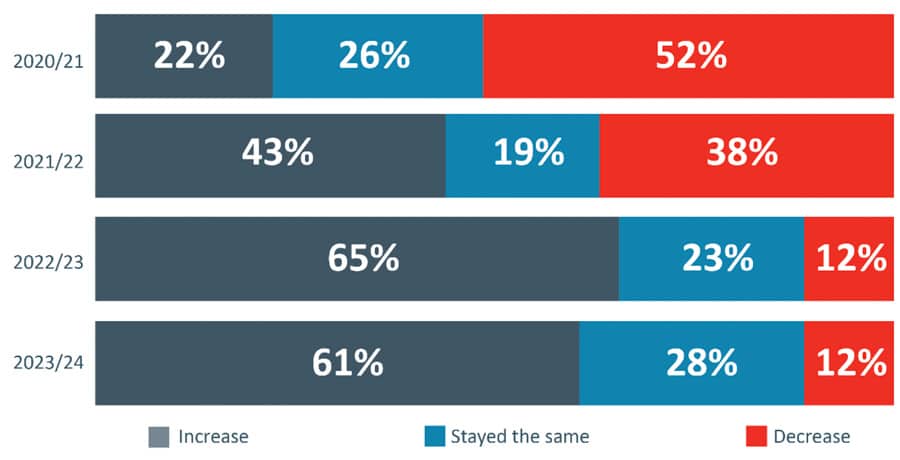
The majority (61%) of responding US colleges and universities indicated that they have received more applications for 2023/24 than for the previous year. Another 28% said application volumes are the same as in 2022/23, and only 12% said they have decreased. This is the second year in which more than 8 in 10 surveyed institutions reported that application volumes had stayed the same or increased compared with the previous year.
Priority markets for undergraduate and graduate programmes
In 2021/22, for the first time in a decade, there were more international graduate students (41%) than foreign undergraduates (36%) studying in the United States, according to the IIE. Separate research from the Council of Graduate Schools (CGS) has also found that international demand for US graduate programmes – especially master’s programmes – is surging.
Considering this trend, the IIE found it relevant, in their 2023 Spring Snapshot, to provide a detailed look at recruitment approaches being used by US educators working to attract international students to undergraduate as well as graduate programmes.
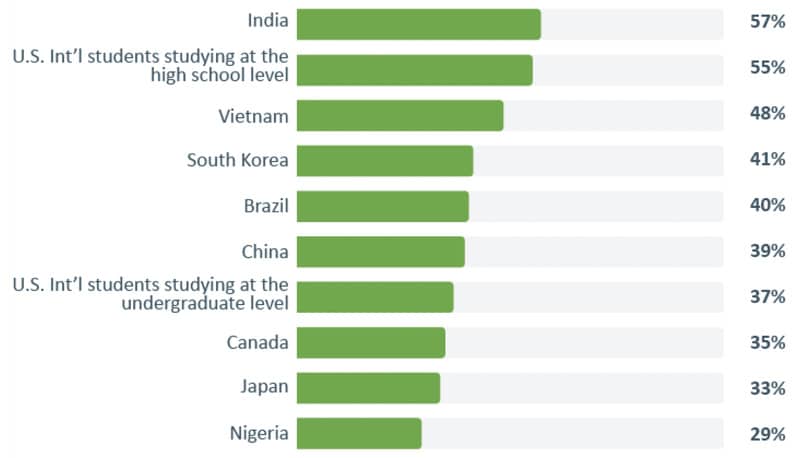
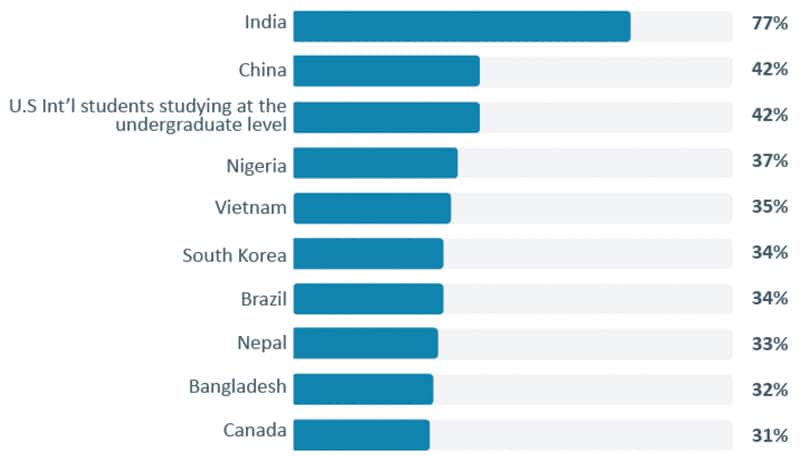
At both the undergraduate and graduate levels, the #1 priority recruitment market in 2023 is India. The focus on India is more intense at the graduate (77%) level than at the undergraduate level (57%). This dovetails with CGS research indicating that Indian students are driving applications and enrolment growth in the US at the graduate level. In fall 2022, for example, Indian students accounted for 38% of all graduate applications to master’s and doctoral programmes.
At the undergraduate level, mentions of Vietnam as a priority market weren’t too far behind (48%) mentions of India, and South Korea (41%), Brazil (40%), and China (39%) are clearly top priorities as well. Recruitment in Nigeria is less intense at the undergraduate (29%) than graduate level (37%). International students studying in the US at the high-school level (55%) and at the undergraduate level (37%) are also key prospects for US undergraduate programmes.
Meanwhile, at the graduate level, China (42%) and Nigeria (37%) were mentioned substantially less often than India. More than a third of graduate recruiters are recruiting in Vietnam (35%), South Korea (34%), and Brazil (34%), and almost as many are recruiting in Nepal, Bangladesh, and Canada. More than 4 in 10 graduate recruiters are also focused on outreach to international students in undergraduate programmes in the US.
Declining Chinese enrolments prompting a more diversified effort
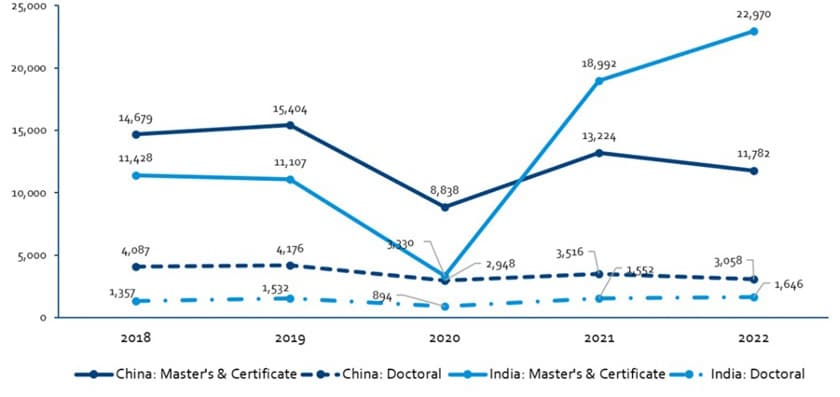
In 2021/22, China remained the top sender of international students to US higher education institutions and claimed 30.5% share of all international students. However, Chinese enrolments fell by -8.6% that year, in contrast to an 18.9% year-over-year leap in Indian enrolments. Given the increased Indian applications for graduate programmes revealed by CGS research as well the intensified recruitment in India we see in the IIE’s Spring Snapshot, it seems likely that the proportion of Indian students in US higher education will grow in the next couple of years from the 21% recorded in 2021/22. The Chinese proportion may shrink slightly, at least at the graduate level, given CGS research showing diminishing Chinese interest in US graduate programmes over the past four years (see chart below).
Recruiters looking at recent trends to establish recruitment priorities
In 2021/22, according to IIE data, the top 10 senders of students to US higher education institutions were:
- China
- India
- South Korea
- Canada
- Vietnam
- Taiwan
- Saudi Arabia
- Brazil
- Mexico
- Nigeria
It’s interesting to see that in 2023, not all of those markets were among the most mentioned recruitment targets in the IIE’s 2023 Spring Snapshot survey. Recruiters are evidently looking at growth trends beyond the top 10 senders of students.
For example, in 2020/21 Japan ranked #11 in terms of enrolments. But Japanese enrolments in US universities grew by 14% in 2021/22, in contrast to a -8.6% decline in Chinese enrolments. It isn’t shocking to see almost as many mentions of Japan (33%) as China (39%), therefore, in the 2023 Spring Snapshot.
Similarly, though Saudi Arabia was the #7 market in terms of enrolments in 2021/22, it was not mentioned as a top 10 recruitment priority for either undergraduate or graduate programmes in 2023. Looking at their chances for the 2023/24 academic year, US educators responding to the Spring Snapshot were clearly feeling the -17% decline in Saudi enrolments in 2021/22 – part of a years-long negative trend.
At the graduate level, we see a concentrated recruitment focus on Nigeria in 2023. It was the 10th largest sender of students in 2021/22 and had grown by 12.3%, making it unsurprising that Nigeria (37%) was mentioned almost as much as China (42%) in the 2023 Spring Snapshot survey by graduate recruiters. Nor is it surprising that Nepal and Bangladesh are priorities for graduate programmes in 2023. Nepal was the 12th largest sender of students in 2021/22 and posted growth of 5.6%, while Bangladesh was the 13th largest sender and contributed 23.2% more students than in the previous year.
These correlations underline the importance of IIE enrolment data trends to US educators planning recruitment strategies for the next academic year.
The power of current international students clearly recognised
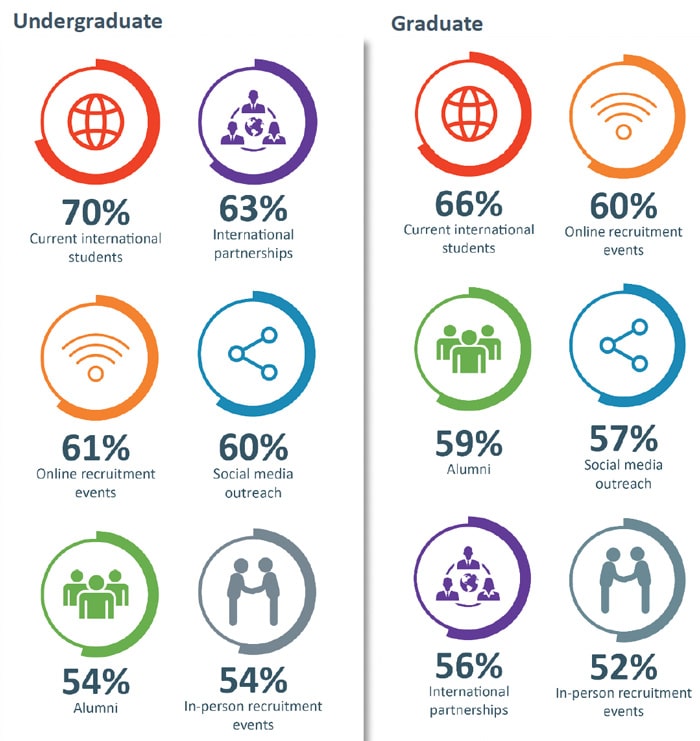
Over two-thirds of responding educators report leveraging current international students’ influence and opinions in their recruitment approaches, significantly higher than the proportion relying on alumni (especially at the undergraduate level). International partnerships have grown in importance at the undergraduate level and are more common among those recruiting for undergraduate than graduate programmes.
Billions of dollars at stake
International students contributed US$33.8 billion to the US economy in 2021/22, down from a peak of US$45 billion in 2018 but up US$5.5 billion from the pandemic-drained year of 2020/21.
Commenting on the year-over-year increase, Dr. Esther D. Brimmer, NAFSA executive director and CEO, said:
“The increase in economic activity is certainly positive news but it should be kept in perspective: it shows we’ve only regained about half the ground lost in the previous academic year. The US is in a global competition for talent and our share of the international student market is declining while other English-speaking countries are seeing their share rise. International students are a well-spring of fresh ideas, talent, and experiences and have fueled American innovation for generations. The Biden administration should lead a coordinated effort to recruit and retain a diverse number of them to our institutions as part of a comprehensive national strategy for international education while Congress must pass legislation to facilitate their ability to study and work here after graduation.”
For additional background, please see:
Most Recent
-
Offering reassurance to international students after they apply is increasingly key to securing enrolments Read More

-
Ireland’s ELT sector reports modest growth in student numbers but weeks are down amid “real and consequential” challenges Read More
-
Japan: Japanese proficiency essential for foreign graduates staying on to work Read More







