


Turkish demand for study abroad remains strong despite economic crisis




- The Turkish economy has been battered in recent years but demand for study abroad remains strong
- Even as student destination preferences are shifting, agencies report that demand is surging this year
The Turkish economy was struggling to fight off a recession even before the pandemic began, with the country weighed down by high debt levels, a weakened currency, and spiralling inflation. Starting in 2020, the pandemic made a bad situation worse and the continuing crisis in Turkey's economy has been marked by even higher rates of inflation (which reached 36% in December 2021), and by a sharp devaluation of the Turkish lira. Overall, the lira lost a staggering 44% of its value in 2021.
And now a further crisis, the war in Ukraine, will place a further drag on the economy this year. The war has further fuelled inflationary pressures in Turkey, driven in part by rapid increases in prices for energy and other commodities for which Turkey is a heavy importer. But the closure of Turkish ports and effective suspension of air traffic also means that Turkish exports are unable to reach markets abroad as well.
With all of that going on, you could be forgiven for thinking that the study abroad market in Turkey must be cooling as well. But a feature panel presentation given at ICEF Virtual Eurasia earlier this month clearly makes the point that demand for study abroad is surging among Turkish students and families.
"More and more families are so price sensitive right now," acknowledged Canan Severoğlu, the founder of education agency Geo Global Education Organization. But she explained as well that agencies are nevertheless working hard to keep pace with demand. "Agencies in Turkey are experiencing a lot of workload after the pandemic due to the accumulation of students who want to study abroad. When new graduates who prefer to study abroad, as opposed to joining the workforce in Turkey, are added to this accumulation, I would say that agencies have also returned to their pre-pandemic intensity [of demand]."
Also speaking on the panel, Eren Göker, the founder of GKR Educational Counselling and President of UED (The Association of International Educational Counselors Turkey) concurred. He added that, in spite of the current financial crisis, "the demand for study abroad is quite strong due to the high numbers of young people graduating from universities and the limited opportunities for employment [in Turkey]."
This is the story of the contemporary study abroad market in Turkey, where there continues to be a huge gap between the number of university spaces available within the country and the great number of secondary school graduates hoping to pursue higher education. As we reported before the pandemic, "Nearly two million Turkish students qualified for university admission in 2018, but only about one in four (just over 471,000) found a place with a university in Turkey."
Destination trends and marketing tips
Mr Göker and Ms Severoğlu further agreed that cost and visa availability (that is, access to visa services and timeliness of processing) are major factors in destination choice this year. They noted as well that students and parents are also looking very carefully at insurance policies as well as refund and consumer protection provisions in the event of programme disruptions.
Mr Göker noted that, reflecting the underlying financial pressures at home, agencies are seeing more interest in work and study programmes this year, including co-op programmes, as well as more inquiries for higher education programmes in relatively affordable study destinations in Europe.
Both panelists noted a growing demand for study in Canada, and the latest immigration data from Canada reveals that the number of study permits issues to Turkish students rose by nearly 36% in 2021.
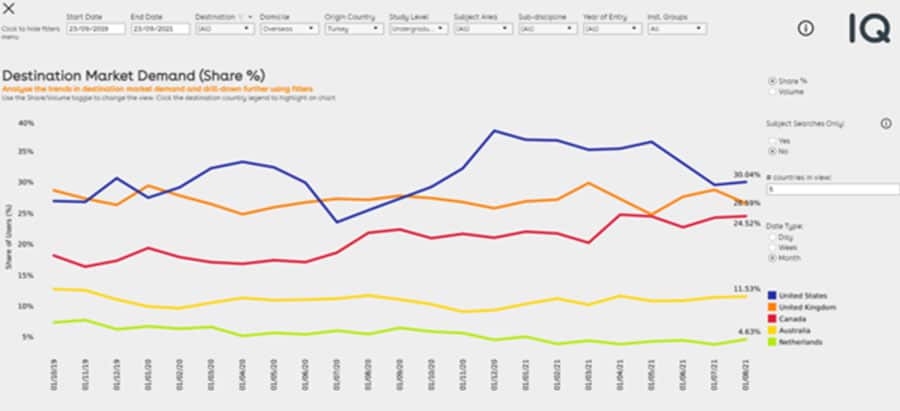
This pattern is borne out as well in some recent demand-side data released by IDP Connect. The following chart reflects the destinations most in demand among students seeking undergraduate programmes. We see the United States and United Kingdom – both traditional leaders among destinations for Turkish students – in the top positions in the chart. But we also see that Canada has earned a greater share of student interest over the period in question (September 2019 to September 2021).
C. Ece Yılmaz, IDP's office manager for Turkey, says that Turkish students particularly appreciate programs that show how they are supported in a host country and that institutions and schools should emphasise those supports in their recruitment marketing in Turkey. “Buddy mentor programmes, career development workshops, mental health and wellbeing support, and academic and language support are all highly appreciated.” She adds that, “Students want to feel protected by their university, particularly when they have problems while studying abroad. As is the case in most Mediterranean countries, Turkish students love being part of the community and groups. Turkish students love the family-focused approach rather than individual life. Institutions should share content about available financial support, internship and work opportunities, and services that can help students obtain a visa and find accommodation. Most Turkish students study abroad to remain permanent residents - this is one of their main motivations, so the promotion of work opportunities is particularly effective.”
For additional background, please see:
Most Recent
-
Academic support and learning resources in TNE: Delivering student success across borders Read More

-
England: Government “remains of the view” that the International Student Levy should go ahead; implementation planned for August 2028 Read More
-
Decline in Indian demand a major factor in softer outlook for foreign enrolment in US higher education in 2026/27 Read More







