Estonia continues to build its foreign enrolment




- Considered a new “education powerhouse” and a “start-up hotspot,” the Baltic country of Estonia is growing in popularity among international students
The EU calls Estonia “Europe's start-up hot spot and one of the safest countries in the world,” two reasons that Estonia’s popularity is increasing among international students. From just 885 students in 2007, Estonia – located in northeastern Europe, beside Russia – now hosts over 5,000 international students and posted double-digit growth every year of the past decade with the exception of the pandemic years of 2020 and 2021.
In 2020, when leading destinations such as Canada and the US lost close to 20% of their total international student populations and Australia lost still more, Estonia saw just a -5% drop in degree-seeking foreign students in the country, and even milder contraction in 2021 (-3%). Study in Estonia reports as well that overall numbers for 2021/22 were buoyed by a 20% year-over-year increase in student commencements.
“New education powerhouse”
According to the BBC, Estonia is “Europe's newest education powerhouse, [outperforming] the major European economies, including the UK, in influential global education tests” such as PISA. Even before COVID, Estonian students were being educated in a system that placed great value on digital learning, with an “e-school system” through which a high proportion of homework and grading was done online.
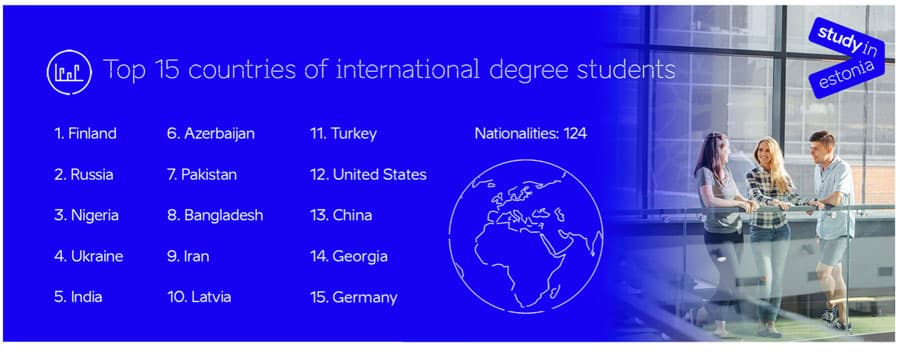
Estonian master’s programmes are the most popular among international students (2,122 students), followed by bachelor’s (1,466) and then doctoral (757) programmes. The government-run Study in Estonia site reveals that though Russian and Latvian students compose the largest proportion of international students in Estonian universities, there is also a great deal of diversity, with 124 nationalities now represented.
One promotional strategy used by the Study in Estonia team has been to publish more than a dozen testimonials from international students about their study experience and decision to remain after graduation to work. The EU notes that participating students “come from countries such as India, Colombia, Spain and Croatia and their jobs include music teacher, landscape designer and software developer, among others.” Most international students who come to the country study in one of the 225 English-taught programmes offered by Estonian universities.
Student satisfaction is high
The country is clearly on the radar of a growing number of international students, not the least because so many students who have studied there are happy with their experience. The 2019 i-graduate International Student Barometer found that 91% of foreign students were satisfied with their study in Estonia’s higher education institutions, and 95% said they chose Estonia “because of the boost it would give to their future careers.”
While studying in Estonia, students are permitted to work part time or even full time without having to apply for an additional visa permission as long as they keep up with their academic requirements, and they can remain in the country for up to nine months after graduation to look for a job in the country.
Start-up culture and jobs are major attractions
Attractive to many students is the start-up culture in Estonia, which owes much to Estonia having the one of the most competitive business tax rate structures in the EU.
Eero Loonurm, the Head of Study in Estonia, told ICEF Monitor that the field of information technology is a draw for many students, including master’s programmes such as e-Governance Technologies and Services, Technology Governance and Digital Transformation, and Innovation and Technology Management. Graduates can then look for job opportunities in the country. Mr Loonurm notes,
“We have a lot of amazing start-up companies which are ready to recruit international students. For example, Transferwise (Now Wise), Pipedrive, Bolt and Veriff. [We also] have many international companies that have recruited international students for decades: Skype and ABB are some examples. Employability is a key word here!”
The country’s digital sophistication is compelling, adding to the country’s growing reputation for innovation. Mr Loonurm explains:
“Estonia is very famous right now for its digital services and development. It is the first country to offer e-Residency, a government-issued digital identity and status that provides access to Estonia’s transparent business environment. In our paperless government, all the decisions are done with a digital signature.”
Blanketed by many parts by forest and/or national parks, Estonia is also a nature-lover’s dream and is also relatively affordable. Two Estonian cities, Tartu and Tallinn have been listed by Business Insider as two of Europe’s most affordable cities.
For additional background, please see:
Most Recent
-
Breaking: US Department of Homeland Security publishes rule to end Duration of Status for international students Read More

-
Joint sector alert sends a clear compliance message to Australian higher education and VET providers Read More
-
Academic support and learning resources in TNE: Delivering student success across borders Read More