Canada toughens testing and quarantine requirements for international arrivals




- As concern mounts about the spread of more infectious COVID variants, the Canadian government has implemented new rules that govern international travellers’ entry to and quarantine requirements while in Canada
- These rules apply to international students with the exception of unaccompanied minors (e.g., secondary school students or younger)
- Adult students must now take a pre-departure, upon-arrival, and end-of-quarantine COVID test before they can travel to their campuses
- After being tested at the airport, these students must pay for a three-day quarantine at a government-designed hotel before going on to a private residence to complete their 14-day quarantine period
- On the tenth day of their quarantine period, students must take a third COVID test – a test taken at home through an at-home test kit provided for them at the airport – and receive a negative result to end their quarantine
- The new rules and associated processes so far are causing significant frustration among students, travellers, and education stakeholders
Editor's note: This article has been updated and expanded to reflect current government guidance around the now-active testing and quarantine rules (as of 21 February) as well as early industry reaction.
The new travel and quarantine rules the Canadian government first announced on 29 January are now in effect. All travellers to Canada – including international students (with the important exception of unaccompanied minors) – are now required to:
- Show proof of a negative COVID test taken within 72 hours of a scheduled flight to Canada;
- Take another COVID test upon arriving at the airport;
- Pay for a three-night stay in a government-authorised hotel as part of their 14-day mandated quarantine to await the result of their airport test;
- Continue on to a private residence (following negative test results) to complete their quarantine;
- Take another COVID test using an at-home test kit provided for them at the airport, and if the test is negative, end their quarantine period.
To enter the country, “travellers must present proof of having reserved and pre-paid for their accommodation through the ArriveCAN app."
The cost of the hotel quarantine is projected to run as high as CDN$2,000 (US$1,560) since travellers also pay for “associated costs of food, security, transportation, infection prevention and control measures.” The list of government-approved hotels is available online.
Those who obtain negative results will then be required to complete the remaining 11 days of mandatory quarantine at their private residence, subject to increased surveillance. On Day 10 of quarantine, travellers must take another COVID test via a kit provided to them at the airport.
To support the new quarantine requirements, as of midnight 3 February only Vancouver, Toronto, Montreal, and Calgary airports will receive international arrivals, as it is in these major cities that hotels are set up with the approved capabilities for the isolation of passengers.
The new mandatory test upon arrival is in addition to an existing rule that travellers must show negative COVID test results obtained within 72 hours of a scheduled flight before boarding any airplane destined for Canada.
The strict new rules were announced after the government spent days debating the best measures to reduce the risk of new COVID variants entering the country. So far, these variants have been brought into Canada via passengers arriving from the UK, South Africa, Brazil, and Denmark. Currently there are few cases of the variants in Canada, but the mutations are known to be more infectious and the race is on to contain their spread.
A shaky start
The new rules and requirements are posing many logistical challenges and many believe the systems in place to accommodate them are poorly set up. The main source of frustration so far is that booking hotels for quarantine can only be done by phone. Many travellers have not been able to get through on the phone in time for their flights, and have subsequently had to cancel their flights.
Gonzalo Peralta, Executive Director of Languages Canada, notes that an additional problem for international students is around the two telephone numbers provided for booking hotels: 1-800-294-8253 (for travellers coming from within North America) and 1-613-830-2992 (for travellers outside of North America). He notes this is especially problematic given the long waits and dropped calls many are experiencing, and says he is aware of one student who “made 10 attempts to call; on the 11th, there was 3-hour wait before the call dropped.”
In general, says Mr Peralta, the new rules are unnecessarily disadvantaging the international education sector, which has spent millions implementing risk-management procedures during the pandemic. He points out that,
“Languages Canada’s Study Safe Corridor–Travel Safe programme has not had a single COVID case among its students since it launched in October 2020, and it is designed to safely handle infections should any occur.”
In a statement, Mr Peralta adds,
“The latest requirements imposed by government is taking away the ability to work for the 19,000 Canadians employed in our sector by unnecessarily choking the flow of international students. The confusion, the lack of functionality, and the cost of new requirements associated with studying in Canada will result in students postponing studies or choosing a competing destination. It is the equivalent of telling a grocery store owner in one part of the city that, on top of implementing expensive new health and sanitation measures for COVID-19, they can only open from 10:00 a.m. to 10:15 a.m."
How incoming students can prepare
As cumbersome as the new processes appear to be at this point, they are in place and adult students, like all travellers, have to deal with them as long as they are mandated or until new processes are introduced.
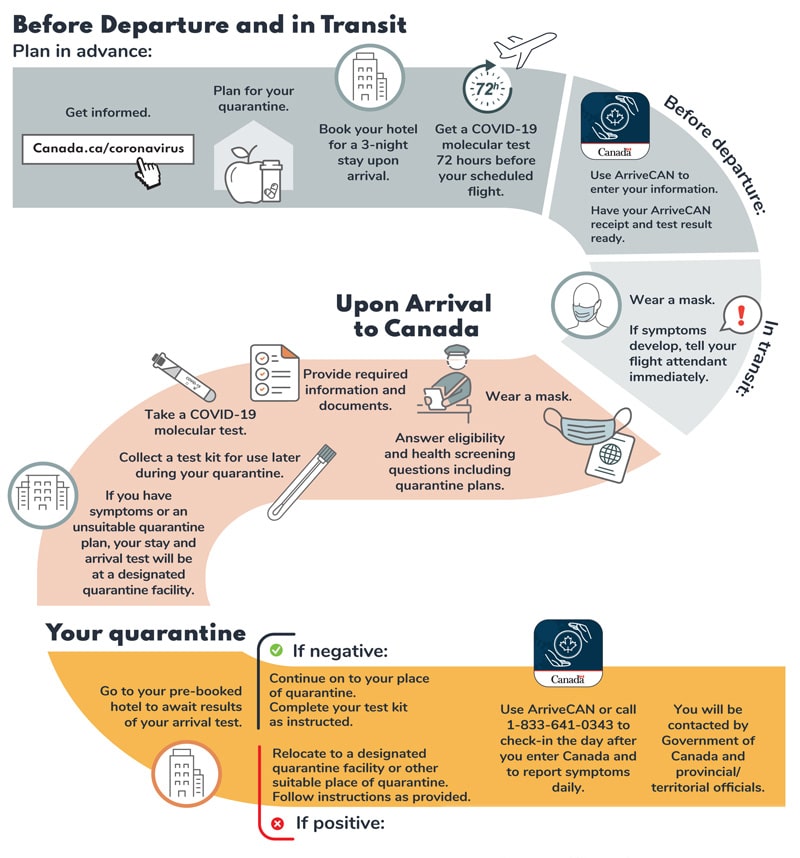
The following graphic from the Government of Canada provides a visual summary of the process for international travellers both before and after arrival in Canada.
Outbound holiday flights suspended
In a further effort to reduce the spread of COVID in the country, the government has negotiated a suspension of flights leaving Canada to some sunny destinations long favoured by Canadian vacationers. Major carriers Air Canada, WestJet, Sunwing, and Air Transat have suspended service to destinations in the Caribbean and Mexico. The airlines are working with the government to bring Canadians currently abroad in those destinations back to the country.
Prime Minister Trudeau said,
"With the challenges we currently face with COVID-19, both here at home and abroad, we all agree that now is just not the time to be flying. By putting in place these tough measures now, we can look forward to a better time, when we can plan those vacations.”
Border remains open to international students
Even as its government clamps down on international travel, the Canadian border remains open to international students, so long as the student holds a valid study permit and the host institution or school has had its COVID-19 readiness plan approved by its respective provincial or territorial government.
For additional background, please see:
Most Recent
-
Breaking: US Department of Homeland Security publishes rule to end Duration of Status for international students Read More

-
Joint sector alert sends a clear compliance message to Australian higher education and VET providers Read More
-
Academic support and learning resources in TNE: Delivering student success across borders Read More