


Market intelligence for international student recruitment from ICEF
6th Mar 2019

Erasmus+ supported nearly 800,000 international placements in 2017

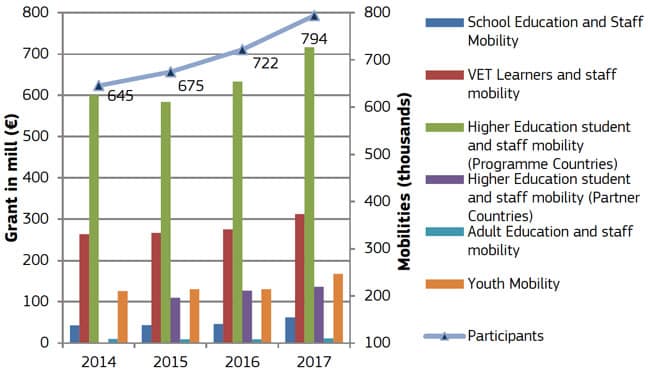
A recent statement from the European Commission highlights that the landmark Erasmus+ mobility programme provided for a record-high participation of just under 800,000 people to study, train, or volunteer abroad in 2017. This represents an increase of 10% over 2016, and reinforces the status of the programme as one of the most ambitious and farthest-reaching mobility programmes in recent history. The total programme budget of €2.6 billion (US$2.9 billion) for 2017 provided for more than 400,000 higher education students and staff to go abroad during the year, including about 34,000 students and faculty who received grants to travel to and from Erasmus+ partner countries around the world. In addition to higher education participants, the programme supported international placements for 160,000 vocational training students and staff and another 158,000 youth and youth workers. erasmus-spending-by-mobility-category-and-total-programme-participants-2014-2017 Erasmus+ spending by mobility category and total programme participants, 2014–2017. Source: European Commission The current Erasmus+ programme is operating with a total budget of €14.7 billion for 2014 to 2020, and with a goal to support the international mobility of nearly 4% of all young people in the European Union over this period. Commenting on the latest statistics, the Commissioner for Education, Culture, Youth and Sport, Tibor Navracsics, said, “2017 became a year in which the programme once again broadened horizons, fostered cultural exchanges, and opened new opportunities in the fields of education, training, youth and sport. The figures confirm the pivotal role Erasmus+ is playing in building a stronger, more inclusive and more resilient Europe. We want to continue with an even bigger and better programme under the new long-term EU budget to ensure that we invest more in young Europeans from an even broader range of backgrounds.” The commissioner refers in part to current proposals to double funding for Erasmus+ within the long-term budget process for the European Parliament. Those proposals aim to expand the budget envelope to €30 billion for 2021–2027.
Patterns of mobility

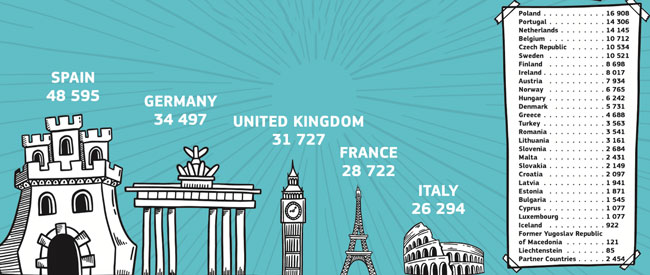
The geographic scope of the programme has expanded considerably over its 30-year history, from an original 11 countries in 1987 to 33 currently. These now include all 28 EU member states along with Turkey, the former Yugoslav Republic of Macedonia, Norway, Iceland, and Liechtenstein. The programme is now also open to partner countries around the world, which accounts in part for the increasing number of programme participants moving to (and from) those partner destinations. Even so, France, Germany, and Spain remained the top sending countries for Erasmus+ participants in 2017. Spain is also the clear leader in terms of study destinations, with Germany, the UK, France, and Italy rounding out the top five most-popular choices for Erasmus+ exchange. leading-destinations-for-higher-education-participants-in-erasmus-exchange-programmes-2016-17 Leading destinations for higher education participants in Erasmus+ exchange programmes, 2016/17. Source: European Commission Among the outcomes reported by student participants:
  • 93% say they are “more receptive to Europe's multiculturalism” after their stay abroad
  • 92% say they become “more able to adapt to and act in new situations”
  • 91% say they improved their language skills during Erasmus+ exchanges or placements abroad
  • 87% say that their stay abroad made them “more tolerant towards others' values and behaviours and better able to cooperate with people from different backgrounds and cultures”

For additional background, please see:

Most Recent

  • For the first time, the Australian government has exercised its powers to cancel an entire course Read More
  • Netherlands: Government-commissioned research finds that international students contribute much more than the public cost of hosting them Read More
  • Korean government introduces new quality controls for universities and agents Read More

Most Popular

  • Which countries will contribute the most to global student mobility in 2030? Read More
  • Research shows link between study abroad and poverty alleviation  Read More
  • Beyond the Big Four: How demand for study abroad is shifting to destinations in Asia and Europe Read More

Because you found this article interesting

For the first time, the Australian government has exercised its powers to cancel an entire course In late 2025, the Australian Parliament passed a package of legislative amendments extending new oversight and regulatory powers...
Read more
Netherlands: Government-commissioned research finds that international students contribute much more than the public cost of hosting them The Dutch government’s economic policy analysis bureau, CPB, has conducted research that shows that international students represent a...
Read more
Korean government introduces new quality controls for universities and agents South Korea met its goal of hosting 300,000 international students by 2027 in mid-2025, two years early, and...
Read more
Australia: Decline in international higher education commencements projected for 2026 Australian universities should not expect an increase in foreign students on their campuses anytime soon, according to Keri...
Read more
The outlook for Indian student mobility through 2030 A new report from QS highlights how Indian demand for study abroad is expected to continue to shift...
Read more
Well-being and pastoral care in TNE: Supporting students to thrive across borders In my previous articles, I have explored why student support must sit at the heart of successful transnational...
Read more
US government warns universities to limit their authorisation of Curricular Practical Training work placements The Trump administration continues to signal its intent to restrict international students’ work opportunities in the United States....
Read more
US Department of State issued 23% fewer study visas to international students in 2025 US Department of State data shows a dramatic -23% reduction in the number of new F-1, M-1, and...
Read more
What are you looking for?
Quick Links