Market intelligence for international student recruitment from ICEF
20th Feb 2019

Taiwan’s foreign enrolment getting a boost from Southeast Asia

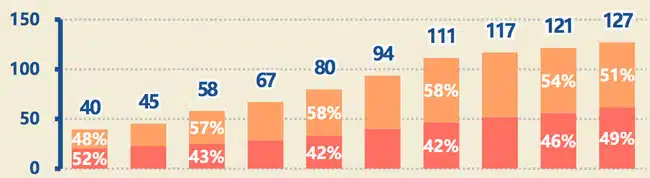
The latest statistical release from Taiwan’s Ministry of Education reveals that foreign enrolment in the country increased by 4.5% to reach nearly 127,000 students in 2018. Total foreign enrolment in Taiwan, in thousands of students, 2009–2018. The proportion of enrolment in degree programmes is shown in dark orange, with enrolment in non-degree programmes in light orange. Source: Taiwan Ministry of Education As the following chart reflects, 49%, or just under 62,000 students, were enrolled in degree programmes last year. The remaining visiting students were enrolled in non-degree studies, including 4% on exchange programmes (4,856 students in 2018), 22% in Mandarin language courses (28,400), 23% in other short-term studies (29,400), and another 2% in technical training (2,400 students). 2018 foreign enrolment in Taiwan by type of study. Source: Taiwan Ministry of Education
The Southbound Policy

Taiwan’s increasing emphasis on markets in Southeast Asia and South Asia – under its “New Southbound Policy” – was a major factor in the 4.5% growth recorded last year. The strategy was enacted in 2016 to encourage closer economic and cultural ties between Taiwan and 18 other Asian markets, including Malaysia, Vietnam, Indonesia, and Thailand. The Ministry of Education reports that more than 50,000 of all international students enrolled in Taiwan in 2018 were from Southbound Policy countries, representing nearly a third of total enrolment last year and a year-over-year increase of 10,600 students from those target markets. Also in 2018, the combined enrolments from Southbound Policy countries surpassed those from China for the first time.

Top sending countries

The top 10 sending markets for Taiwan in 2018 are summarised in the table below. The top ten sending markets for Taiwan, 2018. Proportion of total enrolment is shown for each as is the proportion from each sending country that are engaged in degree studies in Taiwan. Source: Taiwan Ministry of Education Chinese numbers were down 15% in 2018 (from 35,305 in 2017) but still represented nearly a quarter of total foreign enrolment during the year. Malaysia held its number two position and was down marginally from 2017. Vietnam and Indonesia – two notable Southbound Policy markets – both recorded significant growth and surged to become the third and fourth-largest sending markets respectively. Also of note in the table, Chinese, Japanese, South Korean, and Thai students are much more likely to following non-degree programmes in Taiwan. By contrast, students from Malaysia, Indonesia, Vietnam, Hong Kong, and Macau are much more likely to be found in degree studies in the country. Diploma programmes recorded an 11% increase in enrolments, while growth was even higher (34%) for degree programmes. Many more students also came to Taiwan for Mandarin language studies as well, with growth of 20.5% year-over-year. For additional background, please see:

Most Recent

  • Global agent survey provides an early indication of how international student markets are taking shape this year Read More
  • Amidst high visa refusal rates and falling commencements, Australian government opens consultation on reforms to Genuine Student test and financial requirements Read More
  • English UK spearheads effort to strengthen protections for language students affected by school closures Read More

Most Popular

  • Which countries will contribute the most to global student mobility in 2030? Read More
  • Research shows link between study abroad and poverty alleviation  Read More
  • Beyond the Big Four: How demand for study abroad is shifting to destinations in Asia and Europe Read More

Because you found this article interesting

Amidst high visa refusal rates and falling commencements, Australian government opens consultation on reforms to Genuine Student test and financial requirements At the Australian International Education Conference (AIEC) in late October, Assistant Minister for International Education Julian Hill announced...
Read more
English UK spearheads effort to strengthen protections for language students affected by school closures Language schools and education agents depend on each other in a shared ecosystem for student recruitment, but market...
Read more
Are students choosing university programmes aligned with the skills employers need most? Students everywhere are interested in study paths that prepare them for good jobs. But new research suggests that...
Read more
South Korea introduces new incentives for foreign students to develop Korean language skills South Korea achieved its target of 300,000 international students two years early, in mid-2025. The government is still...
Read more
Analysis predicts only moderate university fee increases for international students in Australia for 2027 Just as unstable policies can disrupt the plans of prospective international students, they can also challenge university teams...
Read more
New OECD data underlines growing competition for graduate-level international students New indicators from the Organisation for Economic Co-operation and Development (OECD) highlight the risk to economies of curbing...
Read more
ICEF Podcast: How is the sector responding to ELT school closures and what happens next? In one week in September, two major English language schools closed abruptly. EC English Language Centres ceased trading...
Read more
One test, five markets: What do Australia’s student visa changes mean for South Asian recruitment? After more than a decade working in international student recruitment, I have seen policy changes that have a...
Read more
What are you looking for?
Quick Links