Market intelligence for international student recruitment from ICEF
9th May 2018

China driving enrolment growth in British independent schools


After a marginal decline in 2017, international enrolment in independent secondary schools in the UK have rebounded to report year-over-year growth of 4.5%. In absolute terms, foreign students with parents overseas grew from 27,281 in 2017 to 28,513 this year. This is according to the annual census of the 1,326 member schools of the Independent Schools Council (ISC). This year’s edition was carried out in January 2018 and, as every year, reflects enrolment in ISC schools at that point in time. This international enrolment, and the global engagement of ISC schools generally, remains an important feature of this sector of British education. “Many overseas leaders were educated in British independent schools and this has helped the country to maintain especially good diplomatic relationships with countries like Jordan, Malaysia, and Thailand, says ISC Chair Barnaby Lenon. “Because UK independent schools are so strong, other countries have encouraged them to set up partner schools abroad; recent years have seen such schools established in China and the Middle East and this has strengthened relationships with these important trading partners.” The more than 28,500 foreign students (with parents overseas) enrolled this year represent 5.4% of the total enrolment in ISC schools in 2018. ISC notes as well that just over half of its members (51% or 670 schools) hold Tier 4 sponsor licences with UK Visas and Immigration, and thus are able to admit students from outside of the European Economic Area.

Where do students come from?

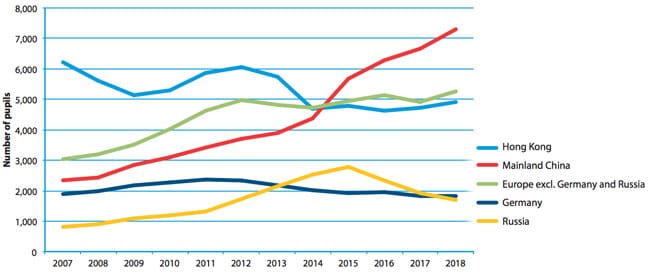
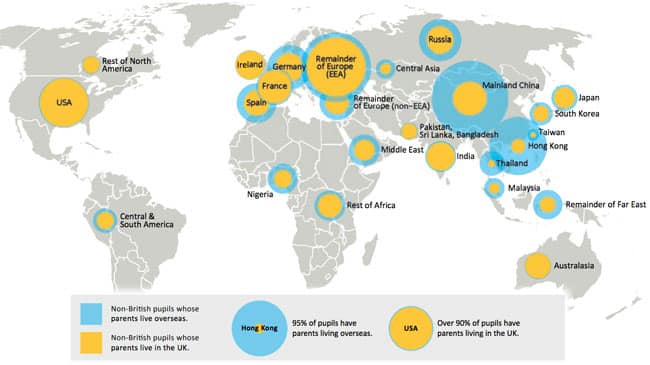
As the following graphic illustrates, nearly half of the foreign students at ISC schools (with parents overseas) come from China and Hong Kong. nationality-of-foreign-students-at-isc-schools-2018 Nationality of foreign students at ISC schools, 2018. Source: ISC It happens that China (again, including Hong Kong) accounted for roughly two-thirds of the net growth reported by ISC schools this year. Indeed, the continuing strength of these major sending markets, has helped to offset more mixed results from the top of the table of source markets for British schools. Leaving aside China and Hong Kong for a moment, Spain was the big gainer among the top international source markets for ISC schools, with 14% year-over-year growth and with Spanish students accounting for 5% of all foreign students at ISC schools. German enrolment has been essentially flat over 2017 and 2018, and is holding steady at roughly 6% of foreign enrolment in British independent schools. Russian numbers, meanwhile, fell off by 12% this year and Russian students again represent about 6% of total international enrolment among ISC members. foreign-student-enrolment-with-parents-overseas-at-isc-schools-for-selected-sending-markets-2007-2018 Foreign student enrolment (with parents overseas) at ISC schools for selected sending markets, 2007–2018. Source: ISC
Campuses abroad

As of this year, ISC schools operate a total of 47 campuses overseas which enroll a combined 32,000 students. In other words, total foreign enrolment in campuses abroad exceeds the number of international students at ISC schools in the UK. Not surprisingly, given the sector’s heavy reliance on the Chinese market, nearly half of these overseas operations (40% or 19 schools) are based in China. Another quarter (12 schools) are found in the Middle East with the remainder based mainly in Southeast Asia and South Korea. For additional background, please see:

Most Recent

  • Study finds strong agent interest in partnering with Japanese universities Read More
  • Canada’s language training sector reinvents pathway programme model in response to policy settings Read More
  • Study highlights poor outcomes for graduates of Indian higher education Read More

Most Popular

  • Which countries will contribute the most to global student mobility in 2030? Read More
  • Research shows link between study abroad and poverty alleviation  Read More
  • Beyond the Big Four: How demand for study abroad is shifting to destinations in Asia and Europe Read More

Because you found this article interesting

Study finds strong agent interest in partnering with Japanese universities For many years, institutions in the Big Four (Australia, Canada, UK, and US) have partnered with educational agents...
Read more
Canada’s language training sector reinvents pathway programme model in response to policy settings In 2019, pathway programmes – joint offerings that link language study with academic programmes – accounted for nearly...
Read more
Study highlights poor outcomes for graduates of Indian higher education Across economies advanced and developing, young degree-holders are finding it more difficult than in the past to secure...
Read more
Canada: Government audit finds impact of international student cap far greater than expected The Office of the Auditor General of Canada (OAG) has released a report that analyses the effect of...
Read more
Australia: Latest enrolment data challenges the government’s assertion of stability for international education this year On 20 March, Australia’s Assistant Minister for International Education, Julian Hill, published a statement entitled Continuity and change:...
Read more
Narrowing bands of compliance: How the UK’s new RAG system will impact international student recruitment The UK Home Office has circulated draft guidance to expand on forthcoming changes to the Basic Compliance Assessment...
Read more
Irish higher education reports a fourth straight year of foreign enrolment growth The number of international students enrolled in Irish universities has been growing steadily from a COVID-era dip in...
Read more
Mexico: A personalised, supportive approach is the key to success in this growing study abroad market Mexican students have traditionally gravitated to the US and Canada for study abroad, but President Trump’s anti-immigration agenda...
Read more
What are you looking for?
Quick Links