


Market intelligence for international student recruitment from ICEF
25th Apr 2017

Japan’s enrolment growth picking up steam

The growth in inbound student numbers that Japan began to show in 2014 has continued through 2016. Every year, the Japan Student Services Organization (JASSO) offers a snapshot of foreign enrolment in the country (as of 1 May each year) and the latest numbers indicate just under 240,000 students for 2016. This amounts to year-over-year growth of 14.8% and an overall increase of nearly 30% since 2013. Speaking to The Japan Times, an education ministry official credited the growth to expanded commercial ties between Japanese corporations and key sending markets, as well as increased promotion of study in Japan by local agents abroad. total-foreign-enrolment-in-japan-and-enrolment-by-level-of-study-1983-2016 Total foreign enrolment in Japan, and enrolment by level of study, 1983-2016. Source: JASSO These recent-year gains put the country on track to reach its long-standing goal to host 300,000 students by 2020. That target certainly seemed out of reach until about 2014, but growth since then has been fuelled by a more active recruiting effort on the part of Japanese institutions and by other recent measures to boost the employability of foreign graduates. As we noted recently, along with its overarching enrolment target, Japan also aims to raise the employment rate for its international graduates to 50% (from the current 30% rate) by 2020. In support of that employment target, the Japanese government is offering new incentives to both graduates and employers, including subsidised company internships, help with finding jobs on graduation, additional Japanese language courses, and more streamlined processes for work visas. For 2016, total enrolment breaks down into roughly 70% (171,000) of students enrolled in higher education and 30% in language schools.

Key sending markets

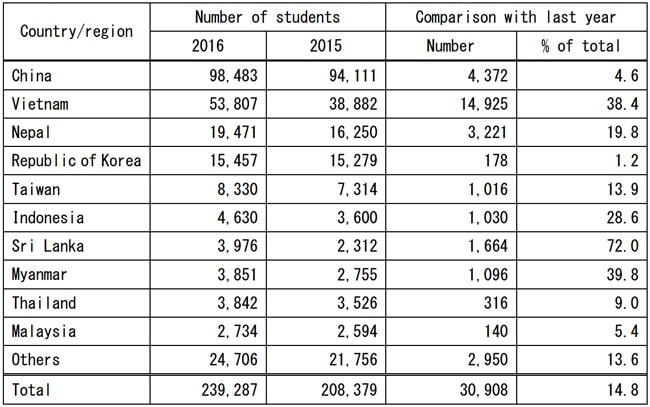
As in previous years, Japan continues to draw almost its entire foreign student population from other markets in Asia. In fact, 90% of all students come from the top ten sending markets, all of which are within the region. top-sending-markets-for-japan-2015-and-2016 Top sending markets for Japan, 2015 and 2016. Source: JASSO As the preceding table reflects, China remains the clear leader among sending markets for Japan. But Vietnam has been the big story in recent years, and was again in 2016 as the fastest-growing market with a very noticeable 38% growth from 2015. In fact, Vietnam accounted for nearly half of total growth in 2016 all by itself. Other notable gainers on the year included Nepal, the third-largest source market with a 20% increase, Indonesia (29%), and Sri Lanka (72%). For additional background, please see:
Most Recent

  • Decline in Indian demand a major factor in softer outlook for foreign enrolment in US higher education in 2026/27 Read More
  • Australia: As visa applications from foreign students fall, the government has set the national target for new international students in 2027 Read More
  • Independent K-12 schools in the UK hosting fewer international students this year Read More

Most Popular

  • Which countries will contribute the most to global student mobility in 2030? Read More
  • Research shows link between study abroad and poverty alleviation  Read More
  • Beyond the Big Four: How demand for study abroad is shifting to destinations in Asia and Europe Read More

Because you found this article interesting

Decline in Indian demand a major factor in softer outlook for foreign enrolment in US higher education in 2026/27 The Institute of International Education (IIE) does a twice-yearly snapshot survey of US institutions that required reading in...
Read more
Australia: As visa applications from foreign students fall, the government has set the national target for new international students in 2027 The Australian government has announced overall settings for “managing the growth” of the country’s international education sector for...
Read more
Independent K-12 schools in the UK hosting fewer international students this year Independent (private) K-12 schools belonging to the Independent Schools Council (ISC) are hosting 57,200 non-British students in the...
Read more
US regulatory agenda for 2026 aims to end “duration of status” and introduce Optional Practical Training and H-1B reforms On 6 July 2026, departments across the US federal government published a unified regulatory agenda for the year...
Read more
China in 2026: Slowing outbound student mobility, accelerating inbound momentum The number of international students studying in China is quickly catching up with the number of Chinese students...
Read more
Surprise hike in international student visa application fees “a direct hit to Australia’s competitiveness” Australia’s international education sector is reeling at new study, work, and working-holiday visa application fees for international students...
Read more
ICEF Podcast: “Good, steady, and disciplined”: New Zealand’s plan for sustainable international enrolment growth Listen in as ICEF’s Craig Riggs and Martijn van de Veen recap some of the latest developments in...
Read more
OECD: International students may be underinformed about job prospects in top destinations For many students from emerging markets in Asia, Africa, and Latin America, there is a dream pathway attached...
Read more
What are you looking for?
Quick Links





