

Market intelligence for international student recruitment from ICEF
13th Feb 2017

US: International graduate enrolment up in 2016 but applications slowing

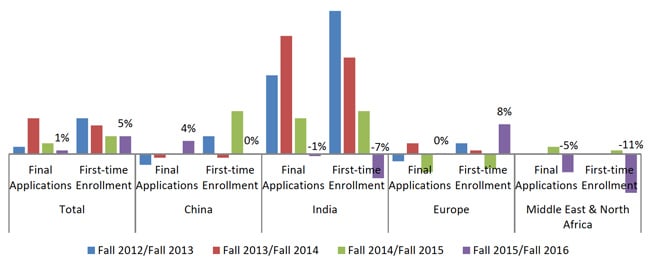
The number of first-time international students enrolled in graduate programmes in the US grew again last year, up 5% over 2015 and on par with year-over-year growth from the year before. This is the top-line finding in the latest Council of Graduate Schools (CGS) report on US graduate school admissions trends. As we noted in an earlier report, however, enrolment growth in US graduate programmes began to slow in 2015, a year that was marked by the slowest growth rate over the past three fall admissions cycles. So while overall enrolment growth didn’t fall away further in 2016, it hasn’t yet recovered to pre-2015 levels yet either. And a corresponding trend with respect to applications volumes suggests that a softer enrolment trend may be on the horizon. Between the fall 2015 and fall 2016 admissions cycles, the total number of applications filed by prospective international graduate students grew by only 1%, down from 3% growth the year before. "International students are and will continue to be a significant part of US graduate enrolment,” concludes the CGS. “However, we may be reaching at a point where we will see fewer surges of overall international graduate enrolment and observe more modest changes overtime." A closer look at the composition of international graduate enrolment gives further weight to this observation. Application volumes were essentially flat in 2016, even with a 4% increase in applications from the key Chinese market. However, increasing numbers of Chinese application files didn’t translate into the classroom in 2016 with Chinese enrolment pegged at zero growth from the year before. changes-in-graduate-application-volumes-and-first-time-enrolment Changes in graduate application volumes and first-time enrolment by selected country or region of origin, fall 2012 to fall 2016. Source: CGS It happens as well that those greater numbers of Chinese applications were offset by a 1% decline in applications from Indian prospects, but also by significant drops in application volumes from other key sending markets, including South Korea (-5%), Brazil (-11%), and Saudi Arabia (-20%). In the end, the story of international enrolment in US graduate schools is essentially this: as goes China and India, so goes the overall enrolment trend. Those two sending markets alone accounted for more than two-thirds (68%) of all foreign graduate students in the United States in 2016. That first-time enrolment of Chinese students was flat at 0% for fall 2016, and Indian commencements off by 7%. Meanwhile, nearly four in ten international graduate students (38%) in US higher education are from China, while another three in ten (30%) come from India. The 7% drop in Indian commencements this year is especially notable in that Indian students have been an important driver of overall growth in US graduate admissions in recent years. More broadly, international prospects filed nearly half (47%) of all applications to US graduate schools for the fall 2016 admissions cycle, and they accounted for 25% of all first-time enrolments (and 24% of total graduate student numbers) for fall 2016. Indeed, more than two-thirds of total enrolment growth in US graduate schools over the past decade has been driven by foreign students. "The continued increase in enrolments is good news for US universities," said CGS President Suzanne Ortega, who remarked on the release of the latest CGS report but also acknowledged a challenging political environment in the US. "We can’t take that position for granted," she added. "Universities in the US and around the world are waiting to see the potential impact of the uncertain policy environment on the mobility patterns of international graduate students." Dr Ortega noted as well that the recent executive order that bars entry or return of US visa holders from specific countries poses a concern. "We must ensure that the US remains an attractive and viable place for the world’s most talented students to pursue education and research," she said. For additional background on recent-year graduate enrolment trends in the US, please see:
Most Recent

  • British Council says student recruitment to UK higher education will get a boost this year from South Asia and the “Trump effect” Read More
  • New Zealand expands post-study work opportunities for international students Read More
  • As Iran retaliates across the Middle East, schools close, students worry, and institutions reassess transnational education Read More

Most Popular

  • Which countries will contribute the most to global student mobility in 2030? Read More
  • Research shows link between study abroad and poverty alleviation  Read More
  • Beyond the Big Four: How demand for study abroad is shifting to destinations in Asia and Europe Read More

Because you found this article interesting

British Council says student recruitment to UK higher education will get a boost this year from South Asia and the “Trump effect” “Demand for UK education will remain resilient over the coming year despite increased competition from intra-regional mobility in...
Read more
New Zealand expands post-study work opportunities for international students In late 2026, New Zealand is rolling out a new Short Term Graduate Work Visa and extending eligibility...
Read more
As Iran retaliates across the Middle East, schools close, students worry, and institutions reassess transnational education The US/Israel-Iran war has touched down in several countries in the Middle East, and international educators and students...
Read more
US: Student visa issuances fell by -36% in summer 2025; OPT uncertainty among factors affecting international student demand The US government has renewed its focus on the Optional Practical Training (OPT) programme that allows international students...
Read more
Canada and India deepen educational ties; India repositions as an equal player in international education As with China in the 2010s, the West is waking up to the reality that India’s “emerging economy”...
Read more
Inbound, outbound, and transnational: the landscape for international education in China continues to evolve China is broadening its approach to international education and talent attraction. The Chinese government continues to support the...
Read more
Australia doubles post-study work visa application fee The Temporary Graduate Visa (Subclass 485) visa allows eligible foreign graduates to work in Australia from 18 months...
Read more
Australia moving to wider sharing of education agent data On 28 November 2025, the Australian House of Representatives passed the Education Legislation Amendment (Integrity and Other Measures)...
Read more
What are you looking for?
Quick Links