Market intelligence for international student recruitment from ICEF
18th Jan 2017

Australia on track for 12% growth in 2016


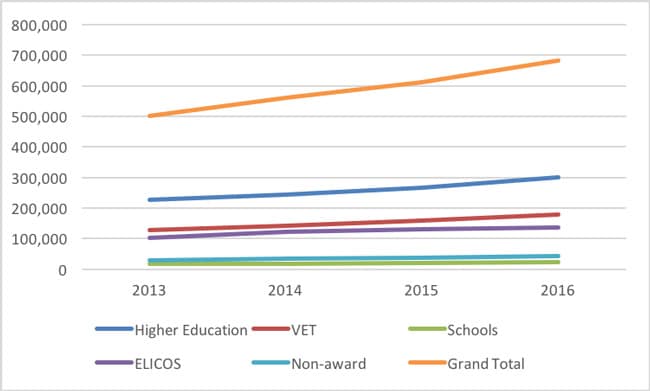
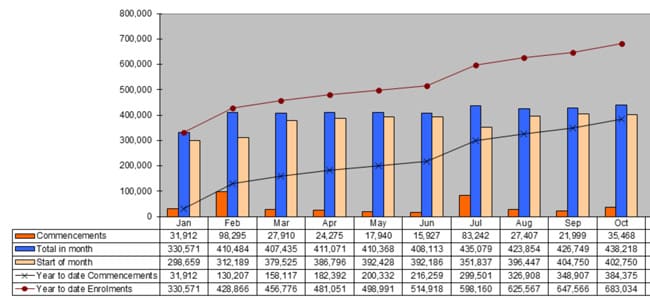
The latest data release from the Australian Department of Education and Training (DET) reveals that the country’s international education sector is tracking toward another year of strong growth for 2016. The department reports that year-to-date October 2016, total international enrolments are up 12%, compared to the same period for 2015, and that commencements have increased by 11%. As is always the case with DET data, there is a necessary caution here in that the statistics are tracking total course enrolments based on reporting from institutions and also from the Department of Immigration and Border Protection (DIBP). This method results in an enrolment count that is considerably higher than the actual head count or FTE enrolments for a given period. As DET explains: "International student enrolment data generally does not represent the number of overseas students in Australia or the number of student visas issued in different countries. Instead data counts actual course enrolments. The exception is the data at the beginning of a month which represents a close approximation to the number of students enrolled on that day.” This approach gives rise to cases where students could be counted more than once if, for example, they enroll twice during the same reporting period (e.g., in an English language programme initially and then a degree programme after). Keeping in mind the department’s suggestion that start-of-month enrolment values provide a closer approximation of actual student numbers, the following chart tracks total enrolments, commencements, and start-of-month numbers through October 2016. foreign-enrolment-in-australian-education-all-sectors-year-to-date-october-2016 Foreign enrolment in Australian education, all sectors, year-to-date October 2016. Source: Australian Department of Education and Training DET reports that all education sectors have seen growth through October 2016, particularly higher education institutions (+13%) and vocational programmes (+12%) - which together accounted for 70% of all international enrolment YTD October 2016. More broadly, all sectors have seen growth from 2013 on, and total enrolment in Australia has grown by 36% YTD October 2016 compared to the same period four years earlier. australian-enrolment-growth-by-education-sector Australian enrolment growth by education sector (and total), YTD October 2013 to YTD October 2016. Source: Australian Department of Education and Training
Sending countries

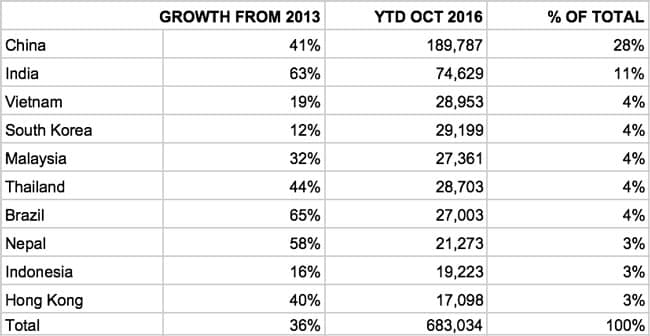
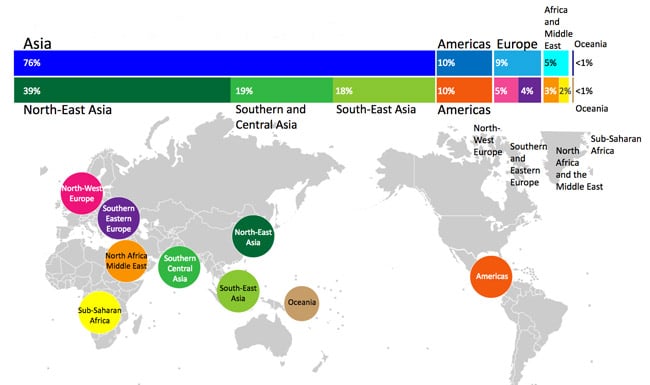
As the following chart illustrates, roughly three in four foreign students in Australia come from Asia. proportion-of-ydt-october0-2016-enrolment-by-world-region Proportion of YTD October 2016 enrolment by world region. Source: Australian Department of Education and Training Not surprisingly, nine of Australia’s top ten sending markets are also found in Asia, Brazil being the one exception. And those top ten countries accounted for nearly seven in ten international students in Australia in 2016. China is far and away the largest sender with 28% of all enrolments YTD October 2016. Taking a broader view, the fastest-growing markets over the four years from from 2013 to 2016 were India (+63%), Brazil (+65), and Nepal (+58). top-ten-sending-countries-for-for-ytd-october-2016 Top ten sending countries for YTD October 2016, with growth indicated for each since YTD October 2013, and percentage of total enrolment for 2016. Source: Australian Department of Education and Training For additional background on recent developments in international education in Australia, please see:
Most Recent

  • Canada and India deepen educational ties; India repositions as an equal player in international education Read More
  • Inbound, outbound, and transnational: the landscape for international education in China continues to evolve Read More
  • Australia doubles post-study work visa application fee Read More

Most Popular

  • Which countries will contribute the most to global student mobility in 2030? Read More
  • Research shows link between study abroad and poverty alleviation  Read More
  • Beyond the Big Four: How demand for study abroad is shifting to destinations in Asia and Europe Read More

Because you found this article interesting

Canada and India deepen educational ties; India repositions as an equal player in international education As with China in the 2010s, the West is waking up to the reality that India’s “emerging economy”...
Read more
Inbound, outbound, and transnational: the landscape for international education in China continues to evolve China is broadening its approach to international education and talent attraction. The Chinese government continues to support the...
Read more
Australia doubles post-study work visa application fee The Temporary Graduate Visa (Subclass 485) visa allows eligible foreign graduates to work in Australia from 18 months...
Read more
Australia moving to wider sharing of education agent data On 28 November 2025, the Australian House of Representatives passed the Education Legislation Amendment (Integrity and Other Measures)...
Read more
Updated forecast projects marginal decline in foreign enrolment in the US through 2030 In 2024, research firm HolonIQ published an analysis of the likely volume of international students enrolled in US...
Read more
Japan surpassed its foreign enrolment target of 400,000 in 2025 Japan’s Immigration Services Agency has announced that the number of international students in the country as of June...
Read more
Australia: Full-year data for 2025 reveals impact of AUD$2,000 study visa application fee on ELICOS sector Australia’s Department of Home Affairs (DHA) has released full-year data on student visa applications and grants in 2025....
Read more
Germany’s foreign enrolments continued to grow in the 2025/26 academic year German universities’ international enrolments continue to grow. In 2025/26, about 420,000 foreign students were enrolled, a +4% year-over-year...
Read more
What are you looking for?
Quick Links