Market intelligence for international student recruitment from ICEF
19th Dec 2016

Foreign enrolment in Russia triples over past decade


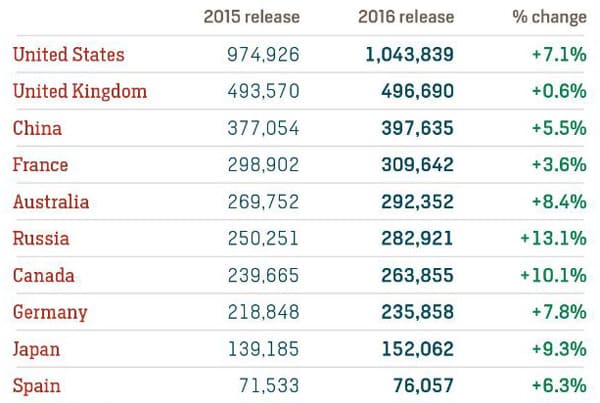
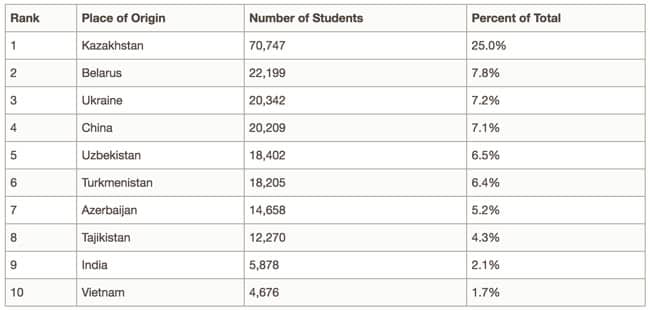
A new report from the Russian Presidential Academy of National Economy and Public Administration (RANEPA) finds that the number of foreign students enrolled in Russian universities has increased nearly three-fold over the past decade. From a base of 100,900 foreign students in 2004/05, total enrolment in Russian higher education reached 282,900 in 2014/15. This represents total growth of 180% over the ten years, and is matched by a commensurate increase in related export revenues which grew to a reported US$1.46 billion in 2015. Year-over-year enrolment growth stands at 17.2% between 2013/14 and 2014/15 alone and RANEPA reports an average annual growth rate of roughly 9% since 2003. “The appeal of Russian education for foreigners has risen in recent years as the decrease in the value of the ruble compared with foreign currencies has made studying in Russia much more affordable,” highlights a recent news item from Russia Beyond the Headlines. “The government is trying to capitalise on this trend in several ways.” In 2015 alone, Russia expanded its scholarship programme for foreign students and a group of 15 leading institutions established a new joint centre for international recruitment. A separate Project Atlas report from the Institute of International Education (IIE) notes that most foreign students in Russia (83%) are enrolled in public institutions. IIE also points out that most foreign students in Russia come from the former Soviet Republics that now make up the Commonwealth of Independent States (CIS). As the following table indicates, the biggest senders from within this group are Kazakhstan, Belarus, and Ukraine. The only non-CIS states in Russia’s top ten sending markets are China, India, and Vietnam with China – and its 20,342 students in 2015 – the largest non-CIS sender by far. top-ten-sending-markets-for-russian-higher-education Top ten sending markets for Russian higher education, 2015. Source: IIE Roughly six in ten foreign students in Russia are enrolled at the undergraduate level, with the balance pursuing advanced degrees or other post-graduate qualifications. Nearly half study Engineering (20%) or Business (27%), with the Humanities (18%) and Health Sciences (12%) standing as the other major fields of study for international students. These totals lead IIE to rank Russia as the sixth-largest study destination, after only the US, UK, China, France, and Australia. However, the IIE figures (as summarised in the table below) appear to understate the enrolments for both Canada and Germany, the 2015 totals for which we have recently reported as 353,570 and 321,569 respectively. international-student-enrolment-in-leading-destination-countries International student enrolment in leading destination countries, 2015. Source: IIE Taking those corrected figures into account, this would suggest that Russia is more correctly positioned as the eighth-leading study destination globally in terms of 2015 enrolments – but also standing on substantial growth over the past several years and poised for further gains going forward. For additional background on Russia’s efforts to build its international enrolment, please see:
Most Recent

  • Studies show countries “at forefront of research” prioritise international collaborations and mobility Read More
  • Australia introduces new rules restricting agent commissions for onshore student transfers Read More
  • ICEF Podcast: Stop losing applicants: How qualification recognition drives seamless international enrolment Read More

Most Popular

  • Which countries will contribute the most to global student mobility in 2030? Read More
  • Research shows link between study abroad and poverty alleviation  Read More
  • Beyond the Big Four: How demand for study abroad is shifting to destinations in Asia and Europe Read More

Because you found this article interesting

Studies show countries “at forefront of research” prioritise international collaborations and mobility Research shows that countries whose academics work frequently across borders with colleagues from another country – or from...
Read more
Australia introduces new rules restricting agent commissions for onshore student transfers As of 31 March 2026, education agents will no longer be permitted to receive commissions from Australian schools...
Read more
ICEF Podcast: Stop losing applicants: How qualification recognition drives seamless international enrolment Listen in as ICEF’s Craig Riggs and Martijn van de Veen recap some of the latest developments in...
Read more
UK’s new international education strategy seeks to build education exports to £40 billion by 2030 The UK has a new International Education Strategy, and its focus is notably different from the previous national...
Read more
How are Australian universities approaching international recruitment in 2026? Studymove founder Keri Ramirez recently presented a webinar anticipating trends in the Australian international education sector in 2026...
Read more
From the Big Four to the Big Fourteen The following article is adapted from the 2026 edition of ICEF Insights magazine, which is freely available to...
Read more
US suspends immigration processing for nationals from 39 travel ban countries – but F, J, and M visa processing will continue Breaking news for 14 January: This article covers the US government travel bans and suspension and review of...
Read more
Is a university degree still the same passport to success? At first glance, the fact that there are more university graduates than ever in advanced economies seems like...
Read more
What are you looking for?
Quick Links