Survey says post-study work options a major factor in choice of destination
The recommendations attached to the latest survey from Hobsons conclude with a stark warning for UK policymakers:
"Failure by government to improve the current status of [post-study] work rights will see revenue generation from international students decline - and rapidly. International student revenue is something UK institutions have long relied on, with the long-term effects of a decline likely to take decades to rebuild."
This observation reflects a strong UK orientation in Hobsons’ International Student Survey 2015. Published earlier this month, the survey gathers responses from 45,543 prospective international students from 210 countries, nearly 40% of which (17,336) were students considering study in the UK. The survey was conducted over 2014 and focused on prospects for the Australian, UK, and Malaysian markets.
The respondents were widely distributed by nationality, with markets such as Nigeria (10%) and India (6%) among the most-represented countries in the survey. Split nearly equally by gender, the study interests of respondents skewed toward advanced programmes, with 59% interested in postgraduate studies and 36% undergraduate.
The earlier point regarding post-study work rights in the UK finds its force in the study’s overarching conclusion that student demand for study abroad is driven by a combination of "soft" experience and "hard" outcome factors. While soft factors relate to the quality of the student’s experience of study abroad – interaction with faculty and peers received the greatest weighting in the survey – hard outcome factors most often related to career or employment goals.
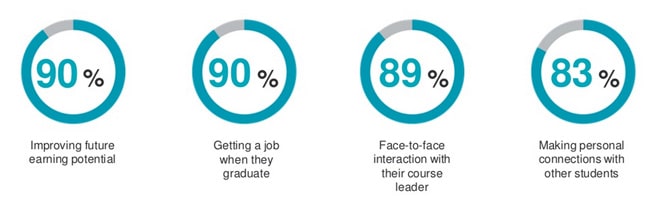
As the following graphic illustrates, 90% of respondents noted "improving future earning potential" as being "highly important, very important or important" in their thinking about higher education. "Getting a job when I graduate" was equally weighted by prospective students, with 90% citing it again as a key consideration in their decision-making for higher education.
The most important factors in studying abroad for international students. Source: Hobsons
Echoing findings from earlier studies of student expectations, factors such as "meeting people from different countries and cultures" and "experience living in another country" were the next-ranked considerations for prospective students in the 2015 survey.
Employment-related outcomes were also in focus when prospective students were asked where study abroad would add value for them in the future. More than seven in ten (71%) said it would improve their overall skill set, while two-thirds (67%) felt study abroad would strengthen their English skills as well as their overall career prospects. A slightly lower percentage (65%) also drew a strong connection between study abroad and improved chances of employment, whereas half believed that international study would lead to higher salaries in the future.
"It’s evident that international students firmly believe that studying at an overseas institution will deliver significant benefits to their employability," says the survey report. "[Programmes] must focus not only on academic success but on helping students to build the broad range of skills and experience that contribute to employability."
How this connects to post-study rights in the UK
The survey report draws a direct line between the importance of employment outcomes for international students and current UK policy. It found that nearly a third (32.2%) of prospective students considering the UK eventually chose to study elsewhere, with 26.8% opting for another country and 5.3% deciding to pursue their studies in their home countries.
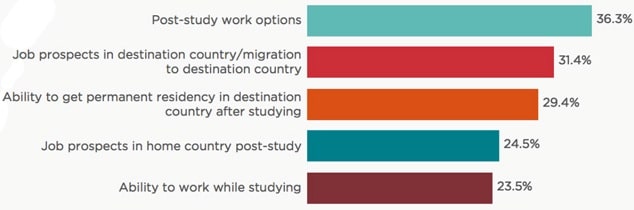
For more than a third of those students (36.3%) who opted not to pursue studies in the UK, "post-study work options" was the most-cited factor in their decision. In fact, and as the following chart illustrates, nearly all of the top five decision factors for students choosing a country other than the UK directly relate to future employment.
Reasons for not studying in the UK. Source: Hobsons
The report describes a global education market where competition is increasing, both in terms of established and emerging study destinations, but also with respect to the continuing development of higher education systems in many sending markets.
The US was the destination of choice for 27.9% of those who chose not to study in the UK (excluding students who opted for an institution in their home country). Canada and Germany were the next-ranked choices at 11% each, "other EU countries" and Australia rounded out the top-five alternate destinations at 9.5% and 9% respectively.
Hobsons points out that many of these destinations have implemented national policies in recent years designed to improve their international competitiveness in international education. Canada, for example, has expanded work rights for international students. Meanwhile, Germany offers international students the chance to study at tuition fees that are "either strikingly affordable or non-existent." And Australia has also established "favourable post-study work rights [and] a clear strategic government push for international recruitment."
The correlation between immigration policy and overall enrolment growth is starkly drawn in the report which points out that Germany’s international enrolment is growing at a notably faster clip than is the case in the UK.
Honor Paddock, a director at Hobsons, added, "The fact that the UK is losing out to European competitors with more a relaxed approach to post-work study and a better reputation for welcoming international students should be a real concern to policymakers. We need to fix this now so that future students aren't put off and our higher education sector doesn't suffer."
This growing awareness of increasing competition from alternate European destinations is echoed in another recent report from the UK-based Higher Education Policy Institute (HEPI). In Keeping up with the Germans?: A comparison of student funding, internationalisation and research in UK and German universities, Nick Hillman, author of the report and the director of HEPI, says, "Societal and political concerns about net inward migration are thought to be limiting the global ambition of the UK’s university sector, whereas Germany has increasingly looked outward as an explicit way of strengthening the higher education system, the research base and the economy. For instance, while the UK has tightened up the post-study work rules for international students, Germany has been liberalising them."
Whether with respect to Germany or otherwise, the evidence is mounting that current government policy is having a significant impact on international education in Britain. It is equally clear that expected employment outcomes are some of the most important drivers of demand for study abroad. Any destination country that hopes to improve its competitiveness, therefore, has to at some point rationalise immigration policy with ambitions for expanded internationalisation.