Market intelligence for international student recruitment from ICEF
2nd Aug 2012

How higher education uses social media

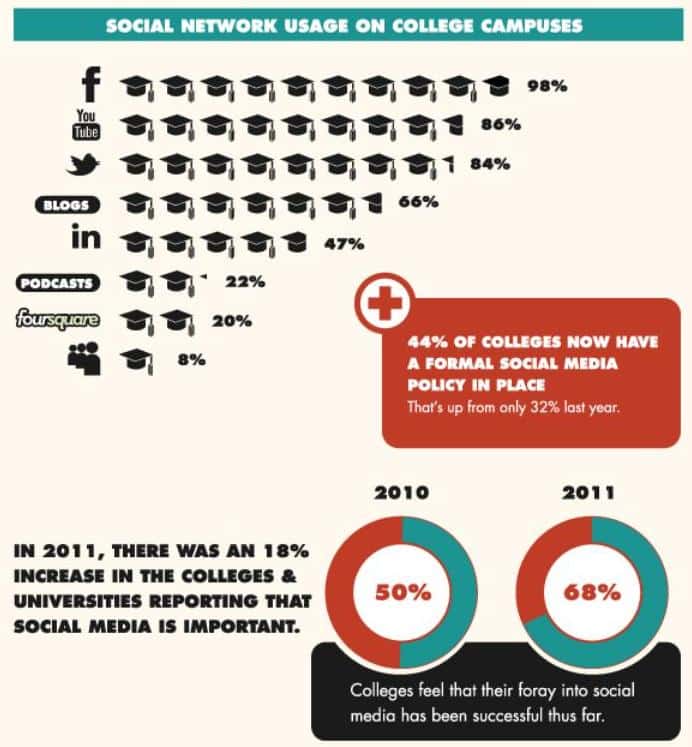
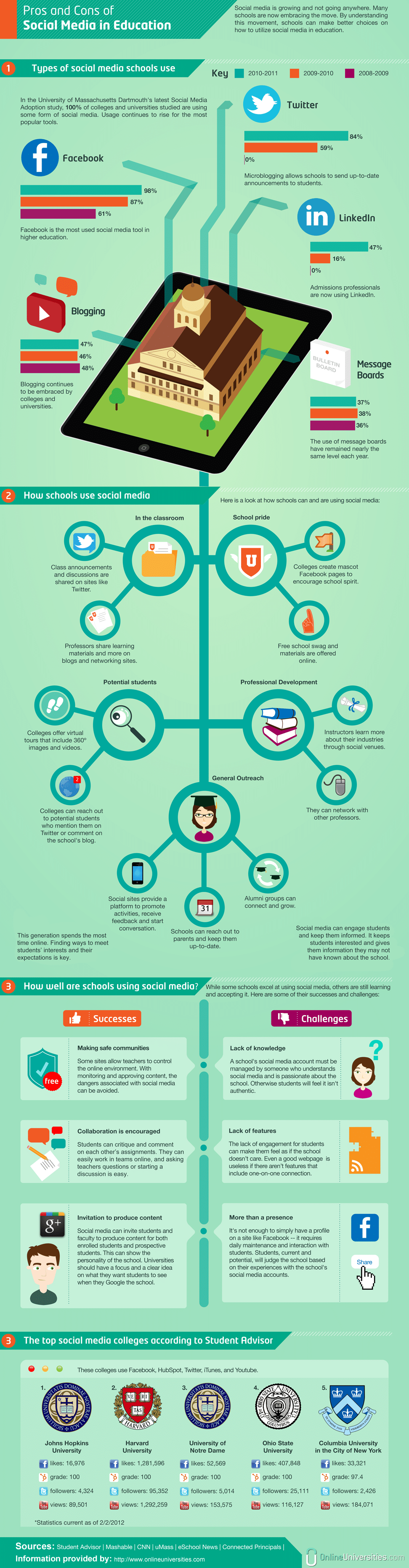
Within the last few years, as social media becomes more integral to students’ lives, educational institutions have begun embracing its use more and more. A recent article from Genius Recruiter presents various ways in which universities are making the most of social media, and ICEF Monitor's article 'Social media as a marketing tool - who does it best?' compares social media performance in the US and the UK, and offers tips on what works best, as well as what institutions can do better. Today we share two infographics below that illustrate how schools have fared with social media over the last few years — what platforms are best, where they’ve succeeded, and the challenges that lay ahead. And speaking of infographics, given their rising popularity on the Internet for websites and Pinterest accounts, you might like to review Genius Recruiter's post containing some ideas for how your school can use this tool to reach students - click here to see how institutions are using infographics. Editor's note: regarding the infographic from onlineuniversities.com below, we have noticed two errors to bring to your attention. The first is that there is evidence of institutions using Twitter in 2008-2009, so the figure of 0% is incorrect. The second is the incorrect seal shown for Johns Hopkins University. Despite these small errors, we felt the infographic provides a convenient overview of social media use in higher education. Social-Media-Education-Infographic Courtesy of onlineuniversities.com college-social-media Courtesy of schools.com See our Marketing Category for more tips, strategies and best practice examples.
Most Recent

  • UK: Visa application withdrawals surpass refusals in Q1 2026 Read More
  • Ascending in world university rankings and highly affordable, Azerbaijan is strengthening its offer to international students Read More
  • Netherlands reports first-ever decrease in foreign enrolment for 2025/26 Read More

Most Popular

  • Which countries will contribute the most to global student mobility in 2030? Read More
  • Research shows link between study abroad and poverty alleviation  Read More
  • Beyond the Big Four: How demand for study abroad is shifting to destinations in Asia and Europe Read More

Because you found this article interesting

UK: Visa application withdrawals surpass refusals in Q1 2026 UK higher education is bracing up to some challenging trends through the first half of the year. Visa...
Read more
Ascending in world university rankings and highly affordable, Azerbaijan is strengthening its offer to international students Azerbaijan – located on the western shore of the Caspian Sea, bordering Russia to the north, Georgia to...
Read more
Netherlands reports first-ever decrease in foreign enrolment for 2025/26 Peak body Nuffic reports that Dutch higher education institutions enrolled 129,764 international students in 2025/26. That total is...
Read more
What is happening to student mobility flows between the Global South and Global North?  In 2026, students in many of the fastest growing markets for schools and universities in the Big Four...
Read more
Offering reassurance to international students after they apply is increasingly key to securing enrolments An important new whitepaper from Uni-Life, “After the offer: what 2,500 student conversations reveal about conversion risk,” reminds...
Read more
Ireland’s ELT sector reports modest growth in student numbers but weeks are down amid “real and consequential” challenges The English Language Training (ELT) sector in Ireland delivered 609,734 weeks of English instruction to 124,789 students in...
Read more
Japan: Japanese proficiency essential for foreign graduates staying on to work An increasing number of fast-growing study abroad destinations – outside of the so-called Big Four of Australia, Canada,...
Read more
Why are so many international students choosing to study in Türkiye? Türkiye used to be a niche study abroad destination, but not anymore. A rapidly growing number of international...
Read more
What are you looking for?
Quick Links