


Proposed H1-B reforms would favour graduates with advanced degrees




International students graduating from US colleges with master’s degrees (and other advanced degrees) may soon have a much better chance of receiving a coveted H-1B visa allowing them to work for up to six years in the United States. Their improved prospects are a result of a policy reform proposed by the United States Citizenship and Immigration Services (USCIS) of the Department of Homeland Security (DHS) that changes the rules of a lottery system used to determine who will receive the H-1B visa. The public is invited to comment on the proposal before 2 January 2019, and the goal is to introduce the reform in April 2019.
H-1Bs are in great demand, with far more applicants than visas available. In 2016, for example, the number of applicants was nearly three times greater than that annual quota of 85,000 visas. As a result, since 2013/14 a lottery system has governed who receives these working visas.
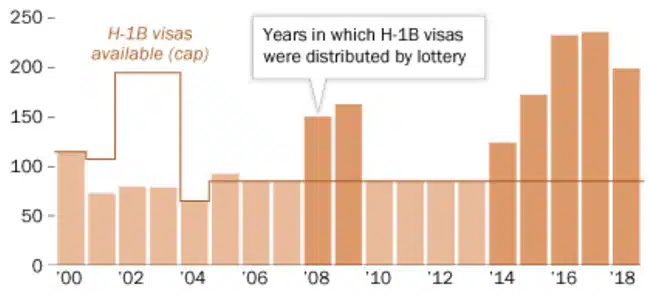
The case for reform
The H-1B visa is valid for three years with a possible three-year extension. It provides a means to stay and gain work experience in the US after graduation and can even be a path to permanent residency. American technology companies in particular benefit from the H-1B visa regime because the programme allows thousands of international graduates with STEM-related skills into the US workforce. Indian students, who represent the second-highest proportion of international students in the US, are particularly likely to be considered for H-1B visas due to the high numbers of these students in graduate-level, STEM-related fields. The impetus for the reform stems from a criticism levelled at the programme in the past. The H-1B programme has been characterised as a mechanism through which American tech companies in particular are able to hire foreign workers – often at below-market wages – which has the alleged effect of taking jobs away from Americans. On 18 April 2017, the President issued an executive order, “Buy American and Hire American,” that called for the Department of Homeland Security to “propose new rules and issue new guidance, to supersede or revise previous rules and guidance if appropriate, to protect the interests of United States workers in the administration of our immigration system.”
The proposal for change
Currently, 85,000 foreigners receive an H1-B visa each year according to the following lottery formula:
- 65,000 visas are reserved for “regular” applicants for H-1B visas – this is known as the “Regular” cap;
- After that, 20,000 H-1B visas are reserved for international students holding advanced degrees from US institutions (also known as the “Master’s” cap).
Going forward, there will still be a total of 85,000 H-1B visas awarded every year. However, the reform would see international students with advanced degrees able to apply for the pool of 65,000 regular visas alongside other foreign workers. If they weren’t selected under the first lottery, advanced degree holders could then apply for the remaining 20,000 H-1B visas. The successful recipients of the remaining 20,000 visas would be selected by USCIS. "The proposed process would result in an estimated increase of up to 16% (or 5,340 workers) in the number of selected H-1B beneficiaries with a master's degree or higher from a US institution of higher education," according to USCIS. USCIS spokesman Michael Bars told CNN that the reform would “ensure more of the best and brightest workers from around the world come to America."
Not all students will benefit
Of the proposed reform, immigration lawyer Greg Siskind explained to The Times of India that the reform “will improve the odds of those with US master’s degrees and higher. However, it will have the effect of reducing chances for those with just a bachelor’s degree.” USCIS does not dispute this notion, saying that the reform would indeed decrease the number of bachelor’s degree holders who would be able to obtain H-1B visas. This is intentional, they note, and geared towards increasing numbers of H1-B holders with advanced degrees: “This process will likely decrease the total number of petitions selected for H-1B beneficiaries with less than a master's degree from a U.S. institution of higher education and those with master's or higher degrees from foreign institutions of higher education. DHS believes that amending its regulations in this manner would increase the chances that beneficiaries with a master's degree or higher from a U.S. institution of higher education would be selected under the H-1B regular cap, which is generally consistent with congressional intent in enacting section 214(g)(5)(C) to prioritize these workers and the administration's goal to improve policies such that H-1B visas are more likely to be awarded to the most-skilled and highest paid beneficiaries.”
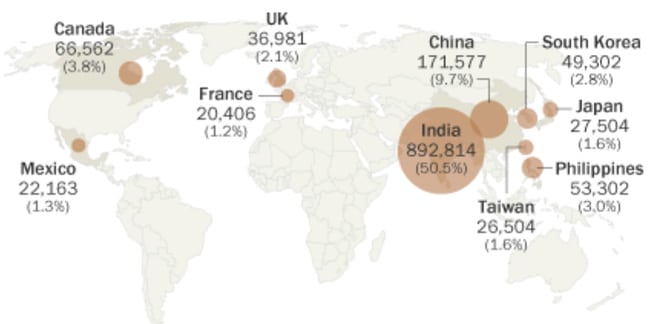
Potential effects on top sending countries
Indian students are far more likely than Chinese students in the US to apply for H-1B status. In 2017, 247,927 Indians applied for an H1-B, compared to only 36,362 Chinese.
Online applications
Under the current system, American employers must file a full H-1B petition for the international workers/graduates they want to hire prior to the lottery selections. Under the proposed reform, employers would instead register their applicants online with USCIS during a specified period before the lottery. If their applicants are selected, only then would the employers have to prepare and file full applications. DHS is proposing the new first step of online registration to “reduce costs for petitioners who currently spend significant time and resources preparing petitions and supporting documentation for each intended beneficiary without knowing whether such petitions will be accepted for processing by USCIS due to the statutory allocations.” For additional background, please see:







