Study finds lots of room to improve in international alumni relations




A majority of US college administrators say that their institutions are not doing enough to connect with international alumni, and nearly two-thirds report having no dedicated staff time for global alumni relations.
These are some of the top-line findings from a new study released today by Academic Assembly and Intead. Global Alumni Management for U.S. Institutions: The State of the Field in 2017 gathers responses from 103 administrators at American colleges and universities for a first-ever national benchmarking survey of best practices in international alumni relations.
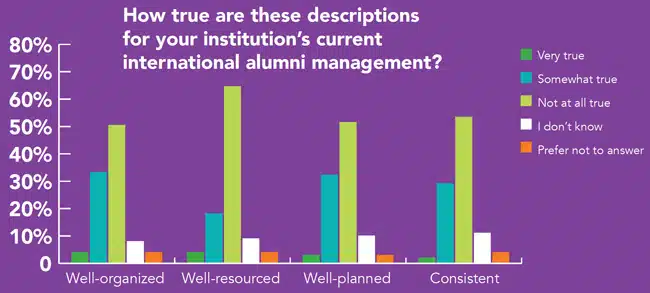
The overarching observation in the study is that there is considerable room for institutions to improve their engagement with international graduates. As the following chart reflects, most respondents do not rate their institution’s current efforts very highly.
The way forward
Ms Dobson, who led international alumni efforts at Tufts University for a decade and now consults and writes widely on the subject today, offers a straightforward path to better global alumni relations. First, put some good, basic data systems in place to capture information about international graduates. Next, start small and build from there – in other words, do what you can but make international alumni part of what your institution does. Finally, recognise the importance of buy-in from senior leadership. The study picks up the question of data management in calling for an entirely new classification for foreign graduates: transnational alumni, a term that recognises that international graduates may go on to further work or study in the US, in a third country, and/or return to their home country over time. “Capturing this kind of nuance requires a commitment to internationalising your [data] systems and annually inviting alumni to update their contact information,” says the report. This is a distinction that makes a lot of sense to Anne Hayner, the associate director for alumni relations with the University of Notre Dame’s Kroc Institute for International Peace Studies. International networking and engagement with foreign graduates are both central to the institute’s programmes, and Kroc has a long-established and active network of global alumni as a result. Even so, Ms Hayner points out that any institution can begin to strengthen their efforts in this area, even with modest budget or staff resources. “Start with the students you have [on campus] now,” she says. “Connect with them and make sure they feel connected to you. Then have a way to capture and update contact information over time whether that’s a simple Google Form or whatever else.” On the question of engaging with an alumni network, Ms Hayner again offers a straightforward approach: “Ask people what they need or want,” she suggests. “For example, part of my job is to help the students professionally network. So we keep them advised of what people are doing in the field through professional or alumni profiles, and we help them to stay connected to faculty or research resources so that they can stay on top of contemporary scholarship in the field.” The benchmarking study echoes the value of starting small and demonstrating success as a means of building linkages within the institution as well as the buy-in of institutional leaders. In practice, global alumni initiatives may originate from different points within the organisational chart, most often from the international office or the alumni or advancement office. The report cautions, however, that, “International alumni relations can’t be managed in a vacuum…Reasonable expectations must be set for interdepartmental cooperation, and a reasonable budget must be allocated. Ideally, a cross-functional team from admissions, advancement, international programmes, and career for grassroots alumni engagement.” Needless to say, the study is focused on the current context for global alumni relations in the US. However, readers in many other host countries will no doubt recognise many of these same characteristics and perspectives within their own institutions. With that in mind, it is fair to say that the findings and recommendations in the benchmarking report offer important insights for international educators around the world. For additional background, please see:
- “Global survey highlights the importance of peer review and detailed insights for prospective students”
- “Student testimonials are an untapped source of competitive advantage in recruitment marketing”
- “Extending your recruitment effort with international alumni”
- “Engaging your alumni in international student recruitment”